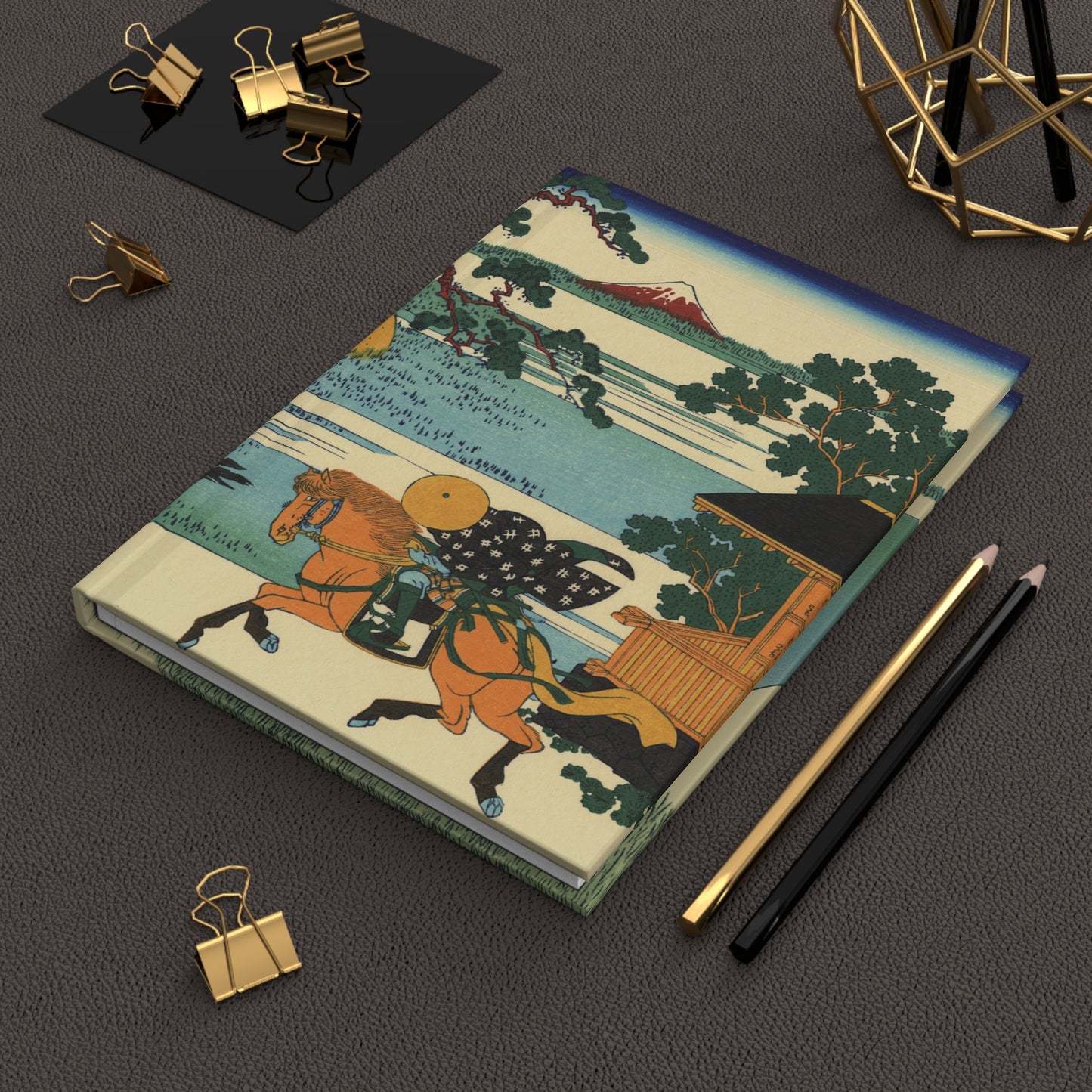
005 : Hokusai - Sekiya Village on the Sumida River
The Visual Language: Composition & Detail
Katsushika Hokusai’s Sekiya Village on the Sumida River (from the Thirty-Six Views of Mount Fuji series) is a dynamic masterpiece renowned for its remarkable sense of speed.
The composition captures three samurai on horseback galloping along a curving embankment, creating a cinematic, frame-by-frame animation effect. Interestingly, the horses on the far right and left are drawn in the exact same posture, merely mirrored.

Although Hokusai knew the anatomically correct running motion of a horse, he deliberately stylized their leg movements to maximize the sensation of extreme speed.
In the background, framed by the pine branches and the official notice board, a majestic "Red Fuji" bathed in the morning light rises above the morning mist, heightening the urgency of the early hour.
The Cultural Soul: Symbolism & Philosophy
The title "Sekiya" refers to a barrier gate (sekisho) established during the Kamakura period, making this area a historical boundary.
The inclusion of the official notice board (kosatsuba) on the right further emphasizes this concept of a physical and spiritual borderline.

Furthermore, Senju (the broader area including Sekiya) was a crucial hub for the Fuji-ko, a popular religious cult dedicated to the worship of Mount Fuji.
By choosing to depict the sacred "Red Fuji"—a rare and highly auspicious motif in the series—Hokusai was likely appealing directly to the deep spiritual reverence the Fuji-ko followers held for the mountain.
A Tale of Speed and Illusion: Influence on the West and Fictional Landscapes
Beyond its domestic popularity, the striking motif of the galloping horses in this print crossed borders and influenced the West.
The dynamic figures of the riders and horses served as a source for the illustrations in NIPPON (published in 1845), a monumental book compiled by the German physician Philipp Franz von Siebold, proving Hokusai's early global impact.
Yet, despite its realistic detail, the landscape is partly an illusion.
While historical records confirm a notice board existed in the Senju post town, its placement in this specific rural setting does not match reality.
Hokusai intentionally fabricated this element to enhance the dramatic composition, demonstrating his brilliant ability to seamlessly blend real topography with artistic fiction.
 Katsushika Hokusai (1760–1849)