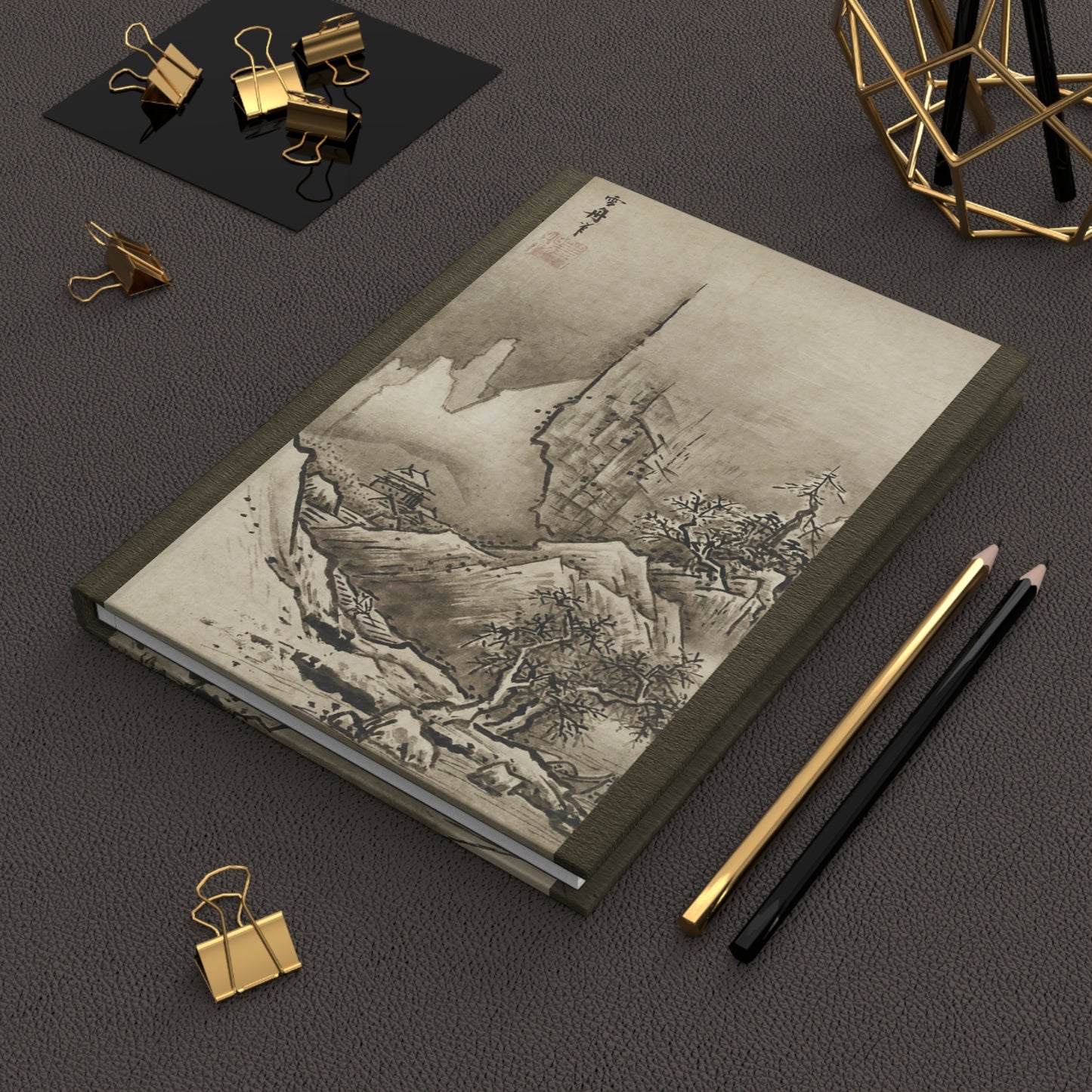
009 : Sesshu - Autumn & Winter Landscape (Shuto Sansui-zu)
The Visual Language: Composition & Detail
Sesshu Toyo’s Autumn and Winter Landscapes is a masterpiece of ink painting that demonstrates his rational and structural approach to composition.
In the "Autumn" scroll, the composition is grounded in the lower half, where a path along a river leads the eye toward distant pavilions, while the vast upper space evokes the expansive autumn sky.
In stark contrast, the "Winter" scroll is dominated by a bold, sheer cliff in the center, making the distant buildings appear smaller and emphasizing the harsh, desolate winter atmosphere.
Both scrolls invite the viewer's eye to travel from the bottom to the top, logically establishing spatial depth and clear relationships between the motifs.
The winter scene captures the vastness of the snowscape using only the contrast of black ink and white paper, with gray washes depicting the texture of rocks and melting snow.
This solid, almost geometric construction has even drawn comparisons to the Cubist works of Paul Cézanne.
The Cultural Soul: Symbolism & Philosophy
As a Zen Buddhist monk, Sesshu's paintings are not merely depictions of physical landscapes but profound spiritual reflections.
After traveling to Ming-dynasty China to study authentic ink painting styles, such as those of the Southern Song court painter Xia Gui, Sesshu established a highly original style characterized by powerful, rough brushwork and firm structural composition.
The figures in the paintings also carry philosophical weight; the autumn scene depicts two scholars conversing, while the winter scene features a solitary traveler climbing a snowy path.
These simplified, croquis-like figures, drawn with just a few swift strokes, reflect the Zen aesthetic of stripping away unnecessary details to reveal the essence of the subject.
The artworks serve as a visual meditation, blending Sesshu’s keen observation of nature with his deep spiritual insight.
An Enigmatic Masterpiece: Abstract Lines and Missing Seasons
Beyond its serene beauty, this artwork holds fascinating mysteries. The most striking element in the winter scroll is the thick, jagged vertical line in the center.
While it represents the edge of a cliff, its upper end fades into the sky, and its lower section morphs into a mountain ridge, creating an ambiguous, abstract space.
This bold line was intended not just for realistic depiction, but to capture the viewer's mind through the pure power of line and form, anticipating modern abstract art.
Furthermore, there is a mystery regarding the seasons. It is widely believed that these two scrolls were originally part of a set of four depicting all four seasons, with the spring and summer scrolls now lost.
Interestingly, the "Autumn" scroll lacks distinct autumnal motifs and was even called the "Summer and Winter Landscapes" during the Meiji period.
Recently, some scholars have suggested it might actually represent spring, pointing to what appears to be an old plum tree in the lower right corner.

Sesshu Toyo (1420–1506)
The legendary master of Japanese ink painting (Sumi-e) who elevated monochrome landscape art to its absolute zenith.
Inspired by Zen philosophy and his travels through Ming-dynasty China, he transcended traditional styles to create a powerful, distinctly Japanese aesthetic marked by bold brushwork and profound spatial harmony.
Revered across centuries as a "Saint of Painting" (Gasei), his visionary mastery of light, shadow, and nature continues to inspire artists and designers worldwide.