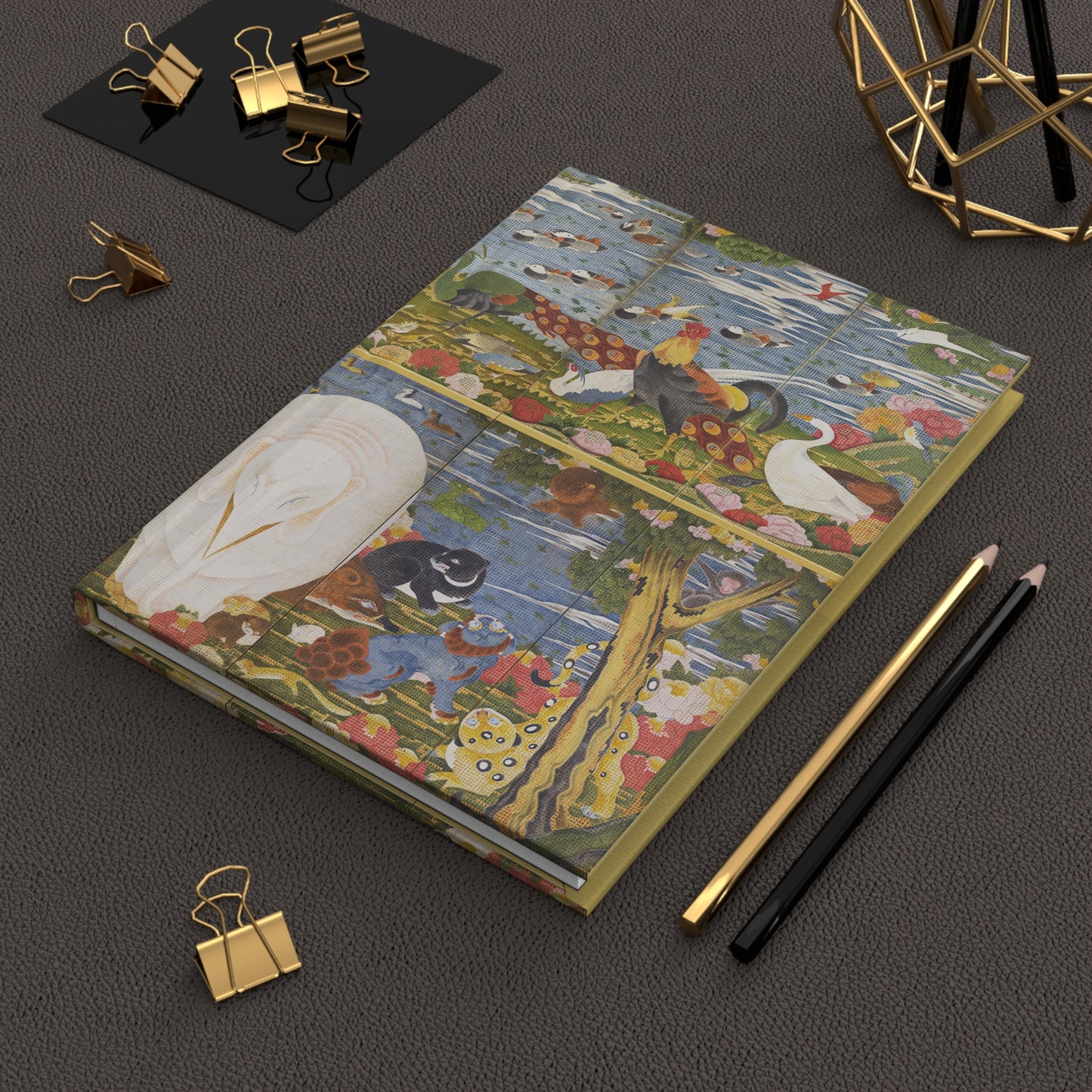
012 : Ito Jakuchu - Birds and Animals in the Flower Garden
The Visual Language: Composition & Detail
Ito Jakuchu's Birds and Animals in the Flower Garden (Chōjū kaboku-zu byōbu) is a monumental pair of six-panel folding screens that stuns viewers with its highly eccentric and incredibly modern aesthetic.
The most striking visual characteristic is Jakuchu's inventive masume-gaki (grid painting) technique.
The entire composition is meticulously divided into a grid of tens of thousands of squares—measuring roughly one centimeter on each side—which are individually colored, making the painting look remarkably like modern pixel art or a tile mosaic.
Recent 3D measurement technologies have revealed that Jakuchu did not simply paint flat squares; he built up the pigments to varying thicknesses, creating a subtle three-dimensional relief effect.
Furthermore, the screens are framed by a unique geometric border reminiscent of Persian carpets, visually enclosing this vibrant world.
The Cultural Soul: Symbolism & Philosophy
Beyond its avant-garde appearance, this masterpiece is a profound expression of Jakuchu's Buddhist faith and the era's intellectual curiosity.
The screens depict an idealized, peaceful utopia where over forty kinds of creatures—ranging from mythical divine beasts like the white elephant (the mount of the bodhisattva Samantabhadra) and the phoenix, to real exotic birds and animals—gather harmoniously.
Scholars suggest that the painstaking, repetitive act of painting each individual square was, for the deeply devout Jakuchu, akin to the spiritual practice of shakyo (copying Buddhist sutras).
At the same time, the artwork reflects the growing interest in natural history (hakubutsugaku) during the mid-Edo period, embodying a desire to catalog the diverse wonders of the natural world.
A Pixelated Mystery: Exotic Influences and Unwavering Devotion
The origin of the revolutionary masume-gaki technique remains one of Japanese art history's great mysteries.
Some theories suggest Jakuchu was inspired by the grid drafts used for Kyoto's Nishijin textiles, while others point to shifuga (woven paper paintings) imported from the Korean Peninsula.
Equally fascinating is how Jakuchu blended myth with reality. While the screens feature mythical creatures, they also include surprisingly accurate depictions of exotic animals like elephants and cassowaries.
In 1728, a live elephant brought from Vietnam actually traveled through Kyoto on its way to Edo. It is highly probable that a young Jakuchu witnessed this magnificent beast with his own eyes.
Combining firsthand observation with boundless imagination, the devoted and solitary artist created an unprecedented, timeless paradise that continues to captivate the digital generation centuries later.

Ito Jakuchu (1716–1800)
A legendary master of the Edo period renowned for his eccentric, ultra-realistic, and brilliantly colored depictions of the natural world.
Best known for his mesmerizing paintings of roosters and the monumental series Doshaku Saie (Colorful Realm of Living Beings), his meticulous technique and obsessive attention to detail transcended traditional styles, creating a vivid, imaginative realism that continues to captivate modern audiences worldwide.