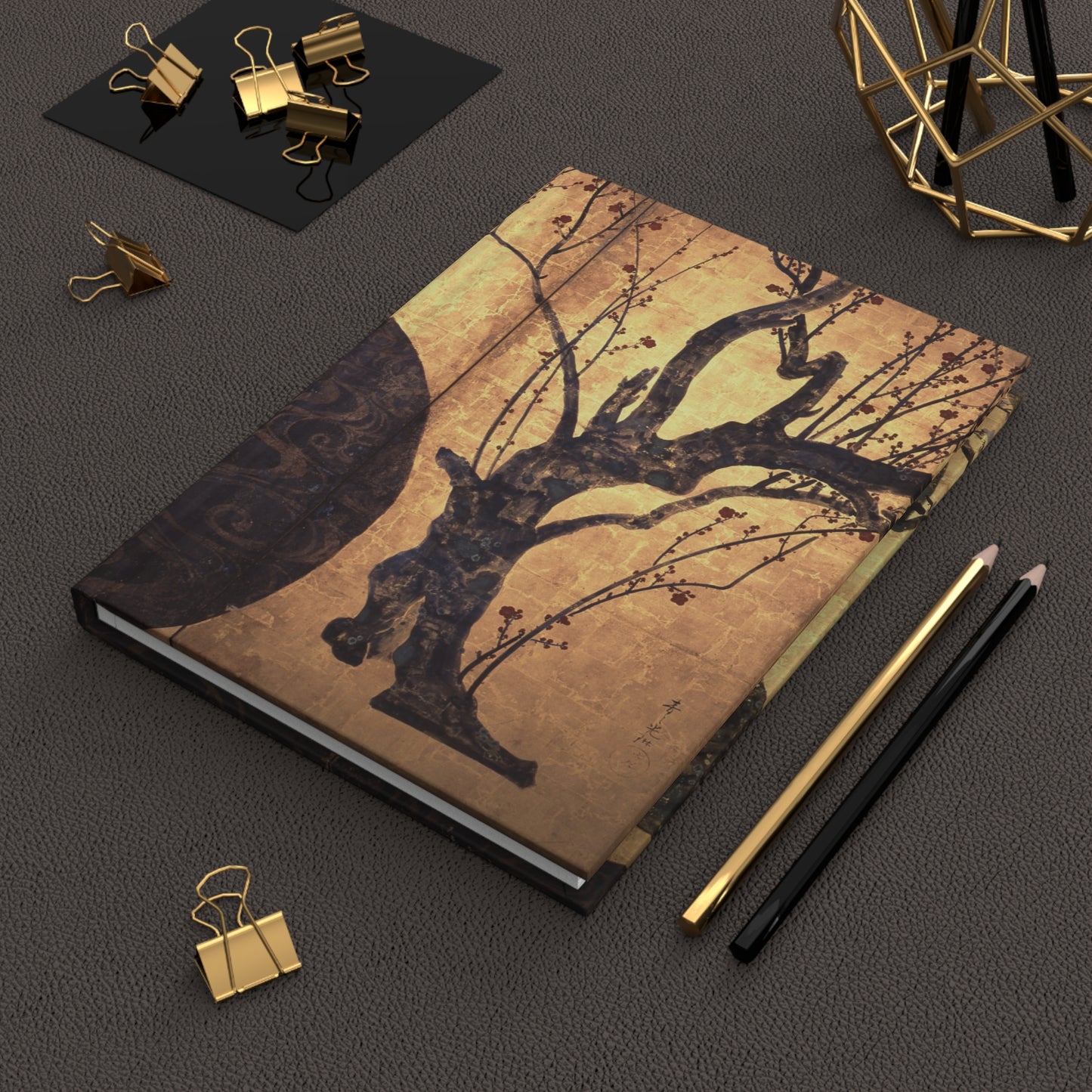
013 : Ogata Korin - Red and White Plum Blossoms (Kohakubai-zu byobu)
The Visual Language: Composition & Detail
Designated as a National Treasure of Japan and currently housed in the MOA Museum of Art, Ogata Korin's Red and White Plum Blossoms (Kohakubai-zu byobu) is a pinnacle of Japanese decorative art, showcasing a highly graphical and dynamic composition.
Spanning a pair of two-panel folding screens covered in dazzling gold leaf, the artwork features two plum trees placed in a sublime asymmetric arrangement.
The vibrant red plum tree on the right is fully contained within the frame, while the older white plum tree on the left dramatically thrusts its branches outside the canvas.
Korin masterfully employs the tarashikomi technique—dropping dark ink onto still-wet lighter ink—to render the mottled texture of the mossy tree trunks.
The blossoms themselves are painted without outlines, a stylized method later known as "Korin Plum" (Korin-ume). In the center, a dark, gracefully curving river creates a striking geometric contrast against the organic forms of the trees, culminating in a masterpiece of abstract design.
The Cultural Soul: Symbolism & Philosophy
Beyond its breathtaking aesthetic, the painting invites profound philosophical and poetic interpretations.
The stark contrast between the two trees has led scholars to suggest that the vibrant red plum symbolizes youth and vitality, while the white plum represents old age and maturity.
The river flowing between them thus becomes a metaphor for the eternal passage of time.
Another fascinating and provocative interpretation views the two trees as male figures vying for the affections of a woman, symbolized by the sensual, swelling curves of the central river.
By stripping away background details and focusing purely on these three elements,
Korin created an evocative, open-ended narrative that reflects the deep Japanese sensibility of projecting human emotions and the transience of life onto nature.
A Scientific Mystery: The Secret of the Black River
For centuries, the precise method Korin used to create the central dark river remained a mystery. Recent cutting-edge scientific investigations have finally revealed his astonishing, unconventional technique.
The river was not painted with black pigment; instead, Korin applied silver leaf to the surface.
Drawing upon his background as the heir to a prestigious kimono merchant family (Kariganeya), he utilized a textile dyeing technique called masking (bosen).
He painted the water ripples with a resist paste, then scattered sulfur powder over the silver.
The chemical reaction (sulfidation) turned the exposed silver into a dark, tarnished black, leaving the protected ripples shining.
This innovative fusion of fine art and traditional craft techniques demonstrates Korin’s experimental genius and his unparalleled ability to push the boundaries of visual expression.

Ogata Korin (1658–1716)