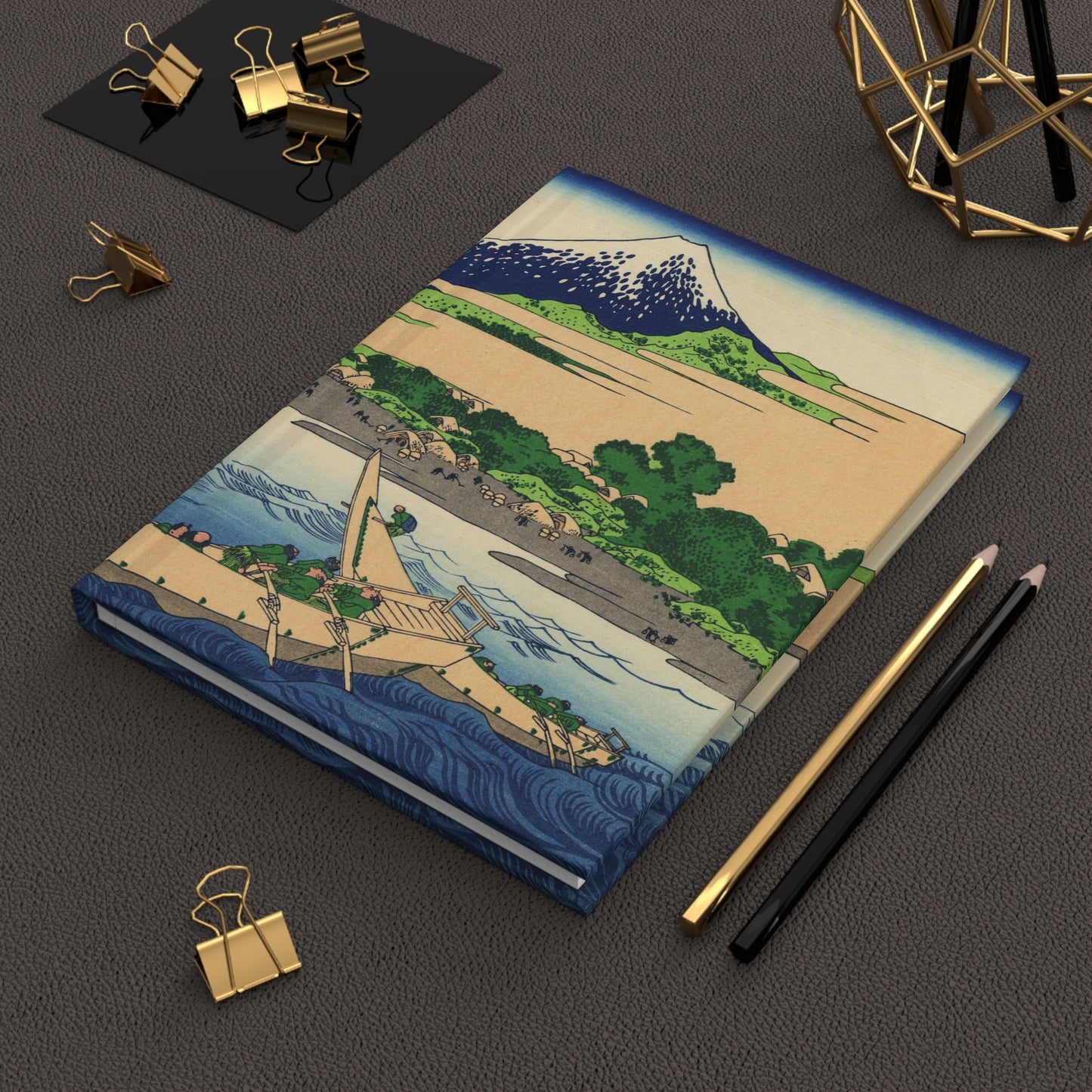
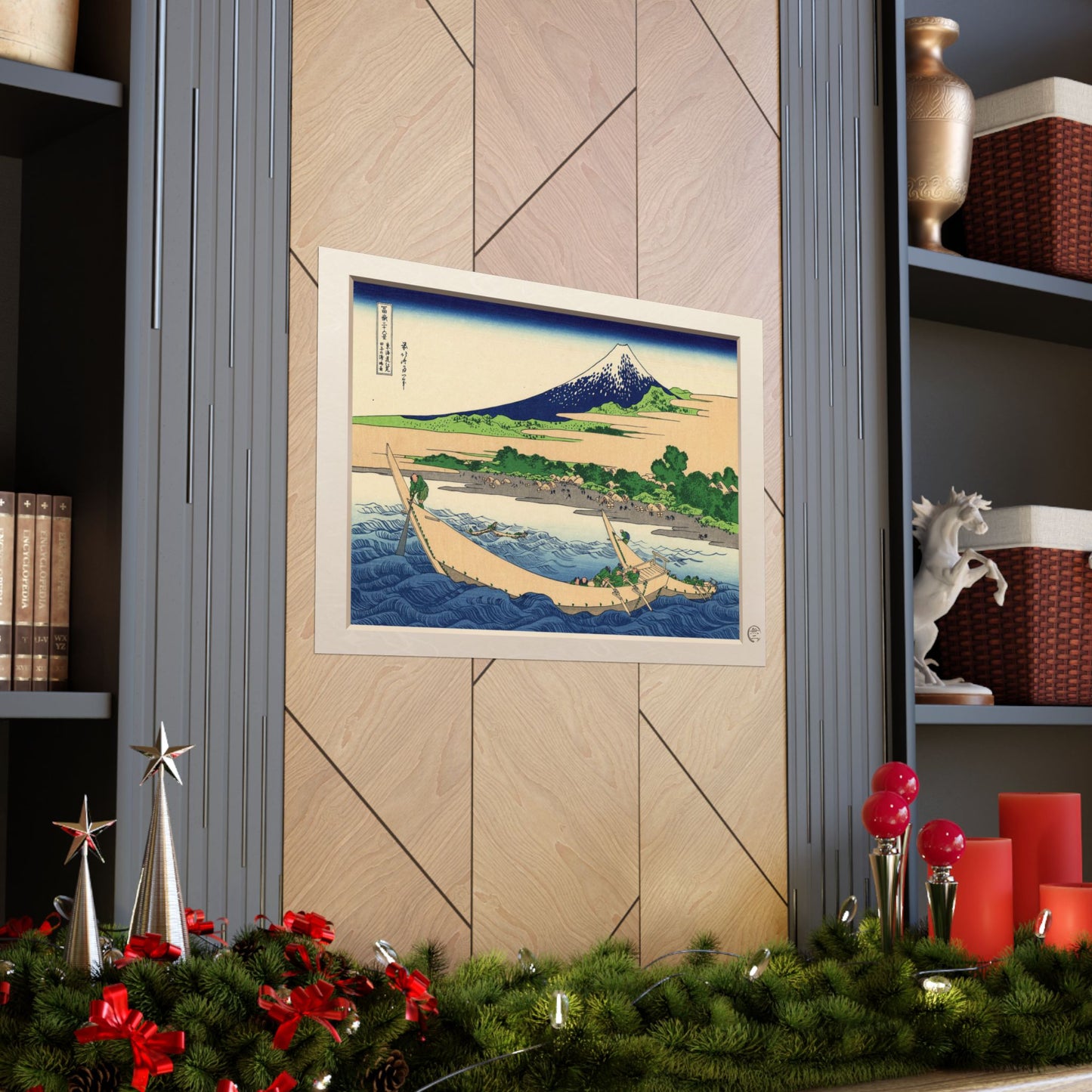
015: Hokusai - Tago Bay near Ejiri on the Tokaido | Thirty-six Views of Mt.Fuji
The Visual Language: Composition & Detail
Katsushika Hokusai’s Tago Bay near Ejiri on the Tokaido from the Thirty-six Views of Mount Fuji series is a masterful display of spatial depth and geometric composition.
The artwork presents an expansive view featuring four boats struggling in the rough sea in the foreground, tiny figures working at salt pans on the beach in the middle ground, and the majestic Mount Fuji rising behind Mount Ashitaka in the distance.
The most striking visual element is the calculated geometric similarity: the sweeping curve of the foreground boat's prow mirrors the exact arc of Mount Fuji's graceful ridgeline.
By echoing these shapes, Hokusai brilliantly emphasizes both the vastness of the space and the towering scale of the sacred mountain.
The Cultural Soul: Symbolism & Philosophy
The setting of this print, Tago Bay (in present-day Fuji City, Shizuoka Prefecture), is an area highly revered in Japanese culture.
It is located directly south of Mount Fuji, offering the closest viewpoint where the ocean meets the mountain.
Since ancient times, Tago Bay has been celebrated in poetry, most famously by the 8th-century poet Yamabe no Akahito, whose poem in the Hyakunin Isshu anthology praises the pure white snow on Fuji's peak seen from this bay.
Hokusai pays homage to this deep-rooted classical literary tradition while simultaneously grounding the scene in reality.
He juxtaposes the eternal, idealized beauty of the mountain with the gritty, everyday reality of commoners—fishermen battling the waves and laborers producing salt—highlighting the resilience of human life within the embrace of awe-inspiring nature.
A Tale of Contrast: Man versus Nature and Printing Variations
A fascinating aspect of this artwork lies in the dramatic tension it creates: the fierce struggle of the fishermen in the tumultuous sea directly contrasts with the calm, immovable presence of Mount Fuji.
Hokusai expertly uses this man-versus-nature dynamic to create a compelling narrative. Furthermore, this print offers a glimpse into the commercial success and production history of the Thirty-six Views of Mount Fuji series.
While the earliest editions (first printings) of this work utilized a distinctive blue outline (a technique known as aizuri), later editions—such as the one frequently seen with black outlines (sumizuri) on the key block—indicate that this specific version was printed after the series became so immensely popular that ten additional views were published.
This subtle variation in ink reveals the massive demand for Hokusai's genius in the Edo period art market.
 Katsushika Hokusai (1760–1849)