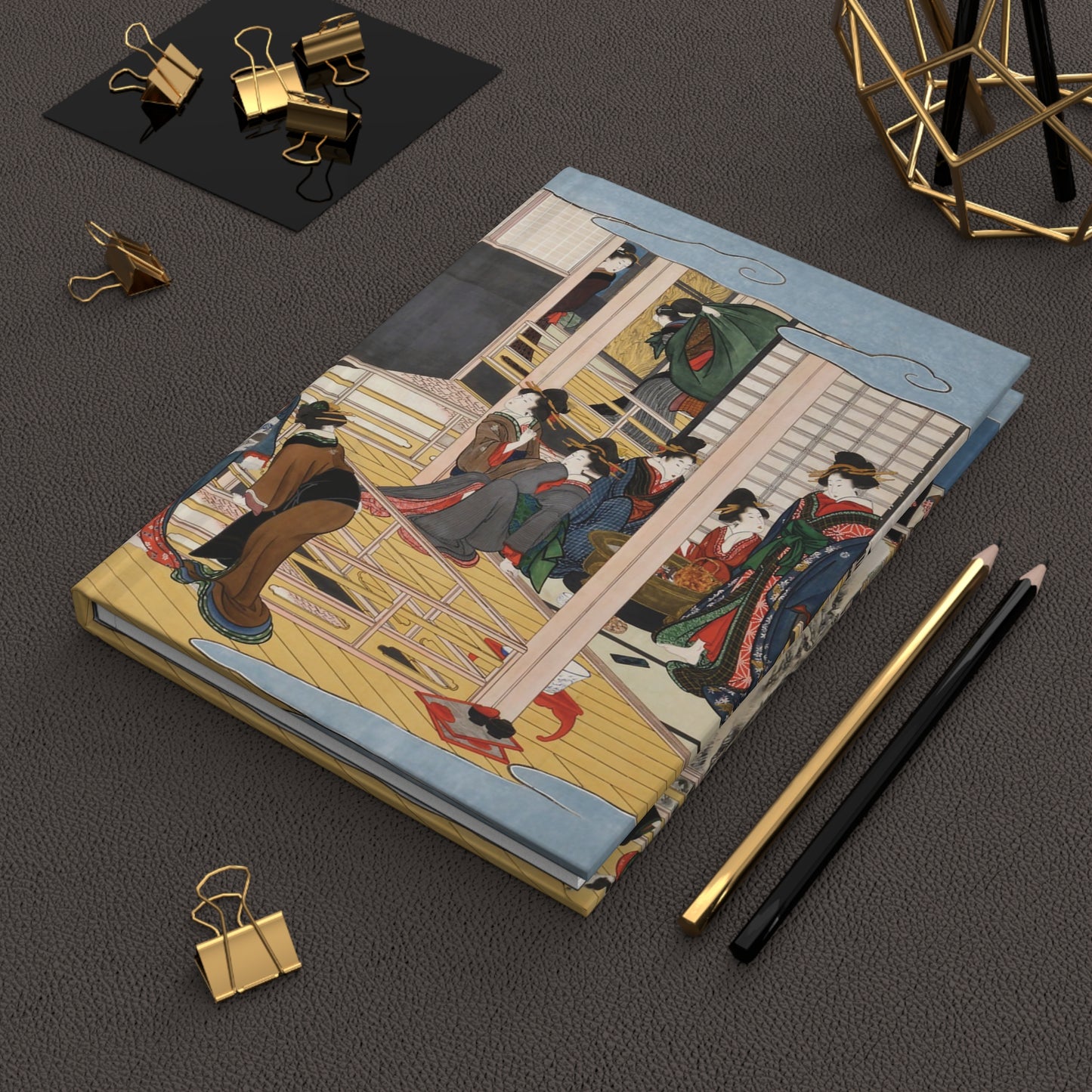
016 : Kitagawa Utamaro - Snow at Fukagawa
The Visual Language: Composition & Detail
Kitagawa Utamaro’s Snow at Fukagawa is a monumental nikuhitsu-ga (original hand-painted painting), renowned as one of the largest in the history of ukiyo-e, measuring approximately 2 by 3.4 meters.
To execute this massive work, Utamaro used only two sheets of high-quality, oversized xuan paper imported from China, seamlessly joined together.
The composition is masterfully stabilized despite the complex gathering of 27 figures.
Pale blue mist gracefully frames the top and bottom of the picture plane, guiding the viewer's eye to the snow-covered pine tree in the courtyard and the vibrant interior of the teahouse.
Utamaro’s unparalleled technical prowess is evident in the precise, unhesitating brushwork, with almost no deviation between the underdrawing and the final lines.
Exquisite details, such as the tōrōbin (lantern-shaped) hairstyles and the sasairo-beni (iridescent green lip rouge) worn by the women, not only add striking color contrasts but also accurately capture the cutting-edge fashion of the early 19th century.
The Cultural Soul: Symbolism & Philosophy
This masterpiece is part of Utamaro's legendary Setsugekka (Snow, Moon, and Flowers) triptych, which elegantly pairs the classical Japanese seasonal aesthetics with Edo's three major pleasure quarters: Fukagawa, Shinagawa, and Yoshiwara.
Set in a Fukagawa restaurant, the painting captures the iki (chic and sophisticated) spirit of the Tatsumi geisha, who were famous for their pride and preference for subdued, refined kimono colors.
Interestingly, in a space that would typically cater to male patrons, Utamaro deliberately replaced all the adult figures with women.
Even the roles traditionally held by men, such as the hakoya (shamisen box carrier), are performed by females.
Along with the depiction of Fukagawa's unique local customs, like the maid carrying a large green furoshiki bundle for bedding (kayoi-yagu), this all-female ensemble creates an idealized, liberated utopia where women can relax and socialize freely.
The 66-Year Mystery: A Masterpiece Rediscovered
Beyond its artistic brilliance, Snow at Fukagawa is enveloped in a highly dramatic history.
After being exhibited for a mere three days in Ginza in 1948, the colossal painting mysteriously vanished.
For 66 years, its whereabouts remained completely unknown, cementing its status as a legendary lost masterpiece.
Miraculously, it was rediscovered in 2012, its vivid colors—including the rare and expensive imported smalt blue (hana-konjō)—impeccably preserved thanks to a protective layer of white gofun (shell chalk) applied to the background to prevent insect damage.
Another intriguing mystery is the complete absence of Utamaro's signature and seal.
Scholars believe this is because the work was commissioned by the Zenno family, wealthy merchants in Tochigi whose family crest subtly appears in the painting.
It was likely intended not for private ownership, but as a communal treasure to be displayed at temples or shrines during special festivals, rendering an artist's signature unnecessary and even intrusive.
 Kitagawa Utamaro (1753–1806)
The definitive master of Ukiyo-e who revolutionized the portrayal of feminine beauty in Japanese art. Renowned for his innovative bijinga (pictures of beautiful women) and masterful use of delicate lines and expressive compositions, his work captured the fleeting grace and inner emotions of his subjects with unprecedented sensuality. His groundbreaking style profoundly impacted Western Impressionism and continues to inspire international art and visual culture today.
--------------------------------------------------------------------------------