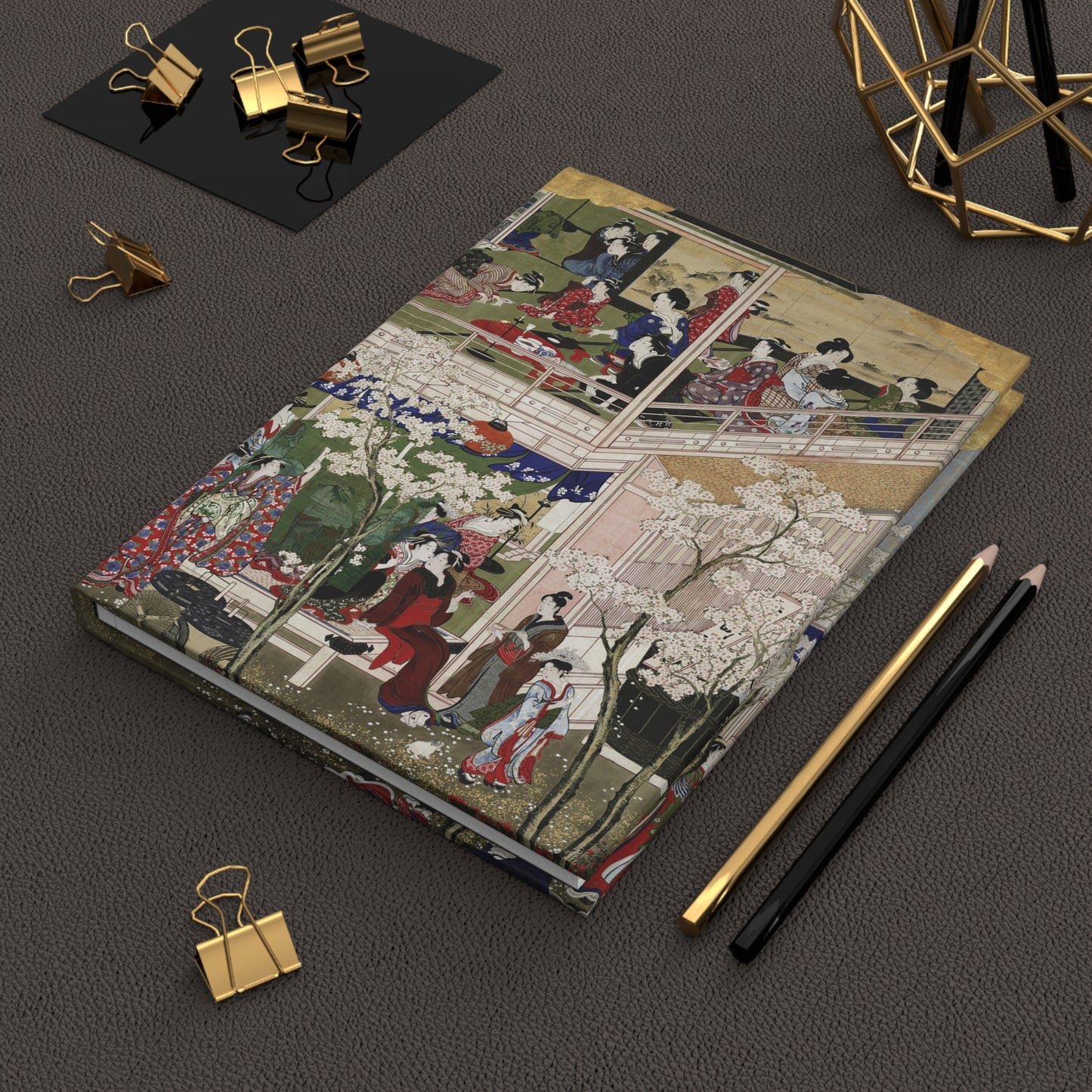
The Visual Language: Composition & Detail
Kitagawa Utamaro's Snow, Moon, and Flowers (Setsugekka) is an unprecedented, monumental triptych of nikuhitsu-ga (original hand-painted hanging scrolls), consisting of Snow at Fukagawa, Moon at Shinagawa, and Cherry Blossoms at Yoshiwara.
These extraordinarily large paintings were executed on imported Chinese Xuan paper, a highly expensive and rare material at the time.
Utamaro combined classical Japanese compositional methods, such as the fukinuki-yatai (blown-off roof) technique that removes architectural obstructions to reveal intricate interiors, with elements of European-style geometric perspective to create a profound sense of space and depth.
He employed a lavish palette of high-quality pigments to meticulously render the complex hairstyles, flowing kimono, and dynamic postures of the numerous figures, showcasing his absolute mastery of line and color on a massive scale.
The Cultural Soul: Symbolism & Philosophy
This masterpiece elegantly intertwines the traditional Japanese aesthetic ideal of Setsugekka—representing the seasonal beauty of winter snow, the autumn harvest moon, and spring cherry blossoms—with the three major licensed pleasure quarters of Edo: Fukagawa, Shinagawa, and Yoshiwara.
Interestingly, in spaces that existed primarily to entertain male patrons, Utamaro deliberately excluded adult men from all three paintings.
All figures, including those performing traditionally male roles like carrying shamisen boxes, are depicted as women.
This playful use of mitate (elegant visual parody) transforms the bustling brothels into an idealized, female-only utopia.
It reflects not only the iki (chic) spirit of Edo's vibrant floating world (ukiyo) but also a profound, poetic appreciation for beauty and the fleeting nature of life.
A 138-Year Journey: Separation and Reunion
Beyond its artistic brilliance, the Setsugekka triptych possesses a highly dramatic history. It was commissioned in the late 18th century by Zenno Ihe, a wealthy merchant from Tochigi, whose family crest (kumaizasa) subtly appears on the women's garments in the paintings.
Following a public exhibition at a temple in 1879, the three masterpieces traveled to Paris during the height of the Japonisme movement and were subsequently separated.
Moon and Flowers eventually found homes in American museums (the Freer Gallery of Art and the Wadsworth Atheneum, respectively).
Snow returned to Japan but mysteriously vanished for nearly 70 years after a brief showing in 1952.
Miraculously rediscovered in 2012, the three legendary scrolls were finally reunited in recent exhibitions, marking their first complete gathering in 138 years—a testament to their enduring, borderless legacy.
 Kitagawa Utamaro (1753–1806)
The definitive master of Ukiyo-e who revolutionized the portrayal of feminine beauty in Japanese art. Renowned for his innovative bijinga (pictures of beautiful women) and masterful use of delicate lines and expressive compositions, his work captured the fleeting grace and inner emotions of his subjects with unprecedented sensuality. His groundbreaking style profoundly impacted Western Impressionism and continues to inspire international art and visual culture today.
--------------------------------------------------------------------------------