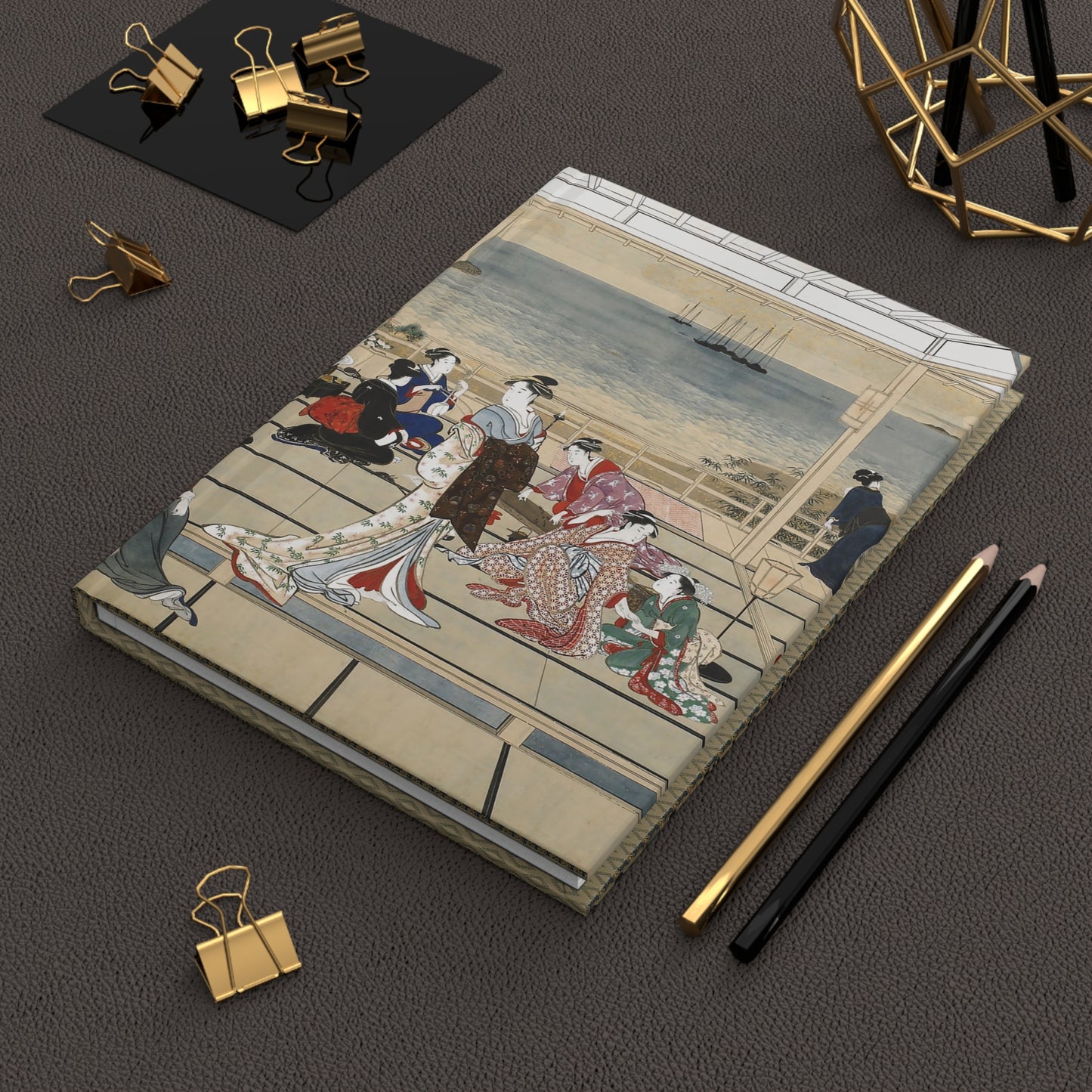
018 : Kitagawa Utamaro - Moonlight Revelry at Dozo Sagami (Moon at Shinagawa)
The Visual Language: Composition & Detail
Kitagawa Utamaro's Moonlight Revelry at Dozo Sagami (also known as Moon at Shinagawa) is a monumental hand-painted scroll (nikuhitsu-ga) and the earliest work in his legendary Setsugekka (Snow, Moon, and Flowers) triptych.
Created around 1788, the painting masterfully blends traditional Japanese and Western artistic techniques.
Utamaro employs European-style geometric perspective to construct the deep architectural interior of the two-story pleasure house, Sagamiya (or Dozo Sagami), while maintaining the elevated viewpoint characteristic of traditional Japanese art.
Looking past the spacious salon, the viewer's eye is drawn toward the expansive, liberating view of the sea, where boats float under a gradually lightening dawn sky and a pale full moon.
Compared to the later works in the series, the color palette is more subdued, and the arrangement of the 16 figures is relatively sparse, creating a refined and tranquil atmosphere.
The Cultural Soul: Symbolism & Philosophy
Shinagawa, the setting of this painting, was a bustling post town facing the sea and a popular pleasure district.
However, instead of realistically depicting the raucous atmosphere of male patrons, Utamaro deliberately created an idealized, female-only utopia.
Among the figures, one can spot playful details, such as children wrestling over an illustrated book in the back, and a woman making a funny face while peeking at another woman's love letter.
Intriguingly, the existence of male customers is only subtly hinted at through indirect clues—the letter being written to a guest, or the silhouette of a man smoking a pipe cast upon a translucent shoji screen in the background.
This clever use of omission and suggestion highlights Utamaro's profound skill in expressing the inner lives and nuanced narratives of his subjects.
A Poetic Genesis and a Cross-Cultural Legacy
This masterpiece not only marks the genesis of Utamaro's grand triptych, hinted at by a framed kyoka (comic poem) by the poet Yomo no Akara hanging from the ceiling, but it also carries a significant global legacy.
Commissioned by the wealthy merchant Zenno Ihe of Tochigi, the painting eventually traveled to the West during the late 19th-century Japonisme boom and was acquired by the American collector Charles Lang Freer in 1903.
traveled to the West during the late 19th-century Japonisme boom and was acquired by the American collector Charles Lang Freer in 1903.
Its innovative composition profoundly influenced Western artists; for instance, the elevated viewpoint and the specific motif of a woman leaning against a railing to gaze at a bay directly inspired James McNeill Whistler's painting The Balcony.
Today, housed in the Freer Gallery of Art, it stands as a testament to Utamaro's genius that captivated both Edo-period Japan and the modern Western art world.
 Kitagawa Utamaro (1753–1806)
The definitive master of Ukiyo-e who revolutionized the portrayal of feminine beauty in Japanese art. Renowned for his innovative bijinga (pictures of beautiful women) and masterful use of delicate lines and expressive compositions, his work captured the fleeting grace and inner emotions of his subjects with unprecedented sensuality. His groundbreaking style profoundly impacted Western Impressionism and continues to inspire international art and visual culture today.
--------------------------------------------------------------------------------