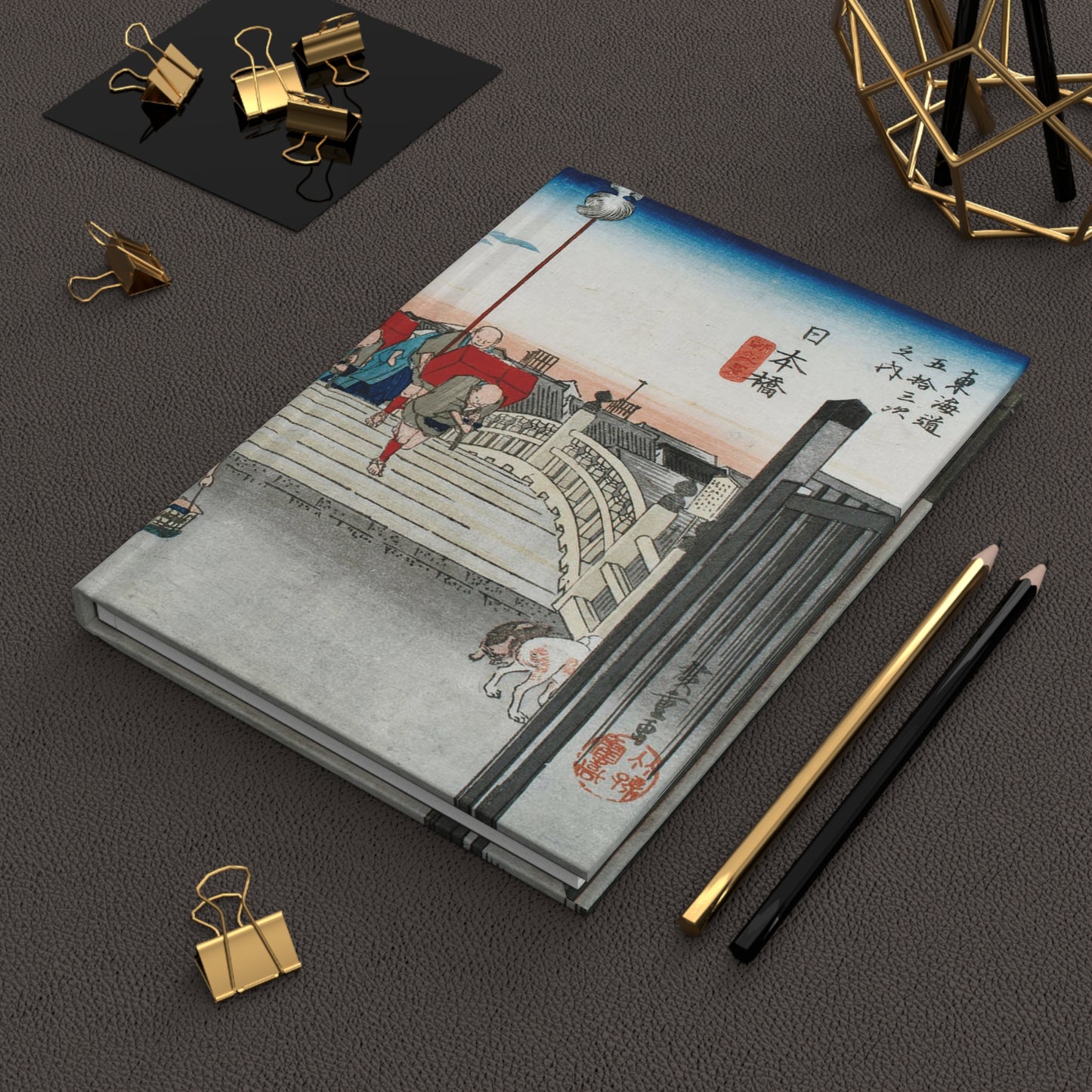
019 : Hiroshige - Nihonbashi, Morning Scene
The Visual Language: Composition & Detail
Utagawa Hiroshige’s Nihonbashi, Morning Scene (from his monumental series The Fifty-Three Stations of the Tokaido) captures a dynamic, almost photographic snapshot of life in early 19th-century Edo. Hiroshige employs a clever compositional device: the large wooden gates (kido) on the left and right boldly frame the foreground, guiding the viewer's eye toward the bridge and the approaching procession.
Interestingly, a fishmonger on the left and dogs on the right are deliberately cropped by these gates. This "snapshot" aesthetic—cutting off figures at the edges—implies a vast, bustling world extending beyond the picture plane.
In rare early printings of this work, beautiful drifting clouds are subtly depicted in the morning sky, showcasing the sophisticated woodblock printing techniques of the time.
The Cultural Soul: Symbolism & Philosophy
This print is not merely a landscape; it is a profound narrative of "beginnings".
Nihonbashi was the geographical starting point of the Five Routes connecting Edo to the rest of Japan. Hiroshige brilliantly layers two temporal beginnings in this single scene.
On one hand, there is the beginning of the day, represented by the energetic commoners—fishmongers returning from the nearby fish market and street vendors taking to the streets as the morning bell strikes to open the gates.
On the other hand, there is the beginning of a long journey, symbolized by the daimyo (feudal lord) procession crossing the bridge.
Under the sankin-kotai (alternate attendance) system, lords were required to travel to Edo, and they often departed at dawn to save on massive travel expenses.
The two feathered spears (keyari) held high indicate a lord of considerable status, yielding over 30,000 koku.
By juxtaposing the strict, formal world of the samurai with the lively, earthly reality of the townspeople, Hiroshige captures the true, breathing soul of Edo society.
A Tale of Two Editions: The Hidden Publisher and the Changing Crowd
The immense popularity of the Tokaido series led to a fascinating production history. Originally, the series was launched as a joint publishing venture between an emerging publisher, Hoeido, and an established shop, Senkakudo.
However, Senkakudo eventually withdrew, and Hoeido took over the project entirely, riding the wave of its explosive success.
Because the woodblocks were reprinted repeatedly to meet massive demand, several variant editions (ihan) exist.
One of the most famous variants of this specific Nihonbashi scene is titled Gyoretsu Furidashi (The Departure of the Procession).
In this later version, while the daimyo procession in the background remains the same, the foreground crowd is completely altered and heavily populated.
It features a lively mix of flower sellers, young apprentices, and a troupe of Sumiyoshi dancers.
Comparing these editions reveals not only the commercial strategies of Edo-period publishers but also Hiroshige's playful willingness to constantly reinvent his own masterpieces.
Utagawa Hiroshige (1797–1858)

The legendary master of Ukiyo-e landscape prints who revolutionized the genre with his poetic use of light, season, and atmosphere.
Known for his lyrical compositions, his masterpiece "The Fifty-three Stations of the Tōkaidō" captured the heart of Edo Japan. His unique "Hiroshige Blue" and dynamic perspectives profoundly influenced Western artists like Van Gogh and Monet.
--------------------------------------------------------------------------------