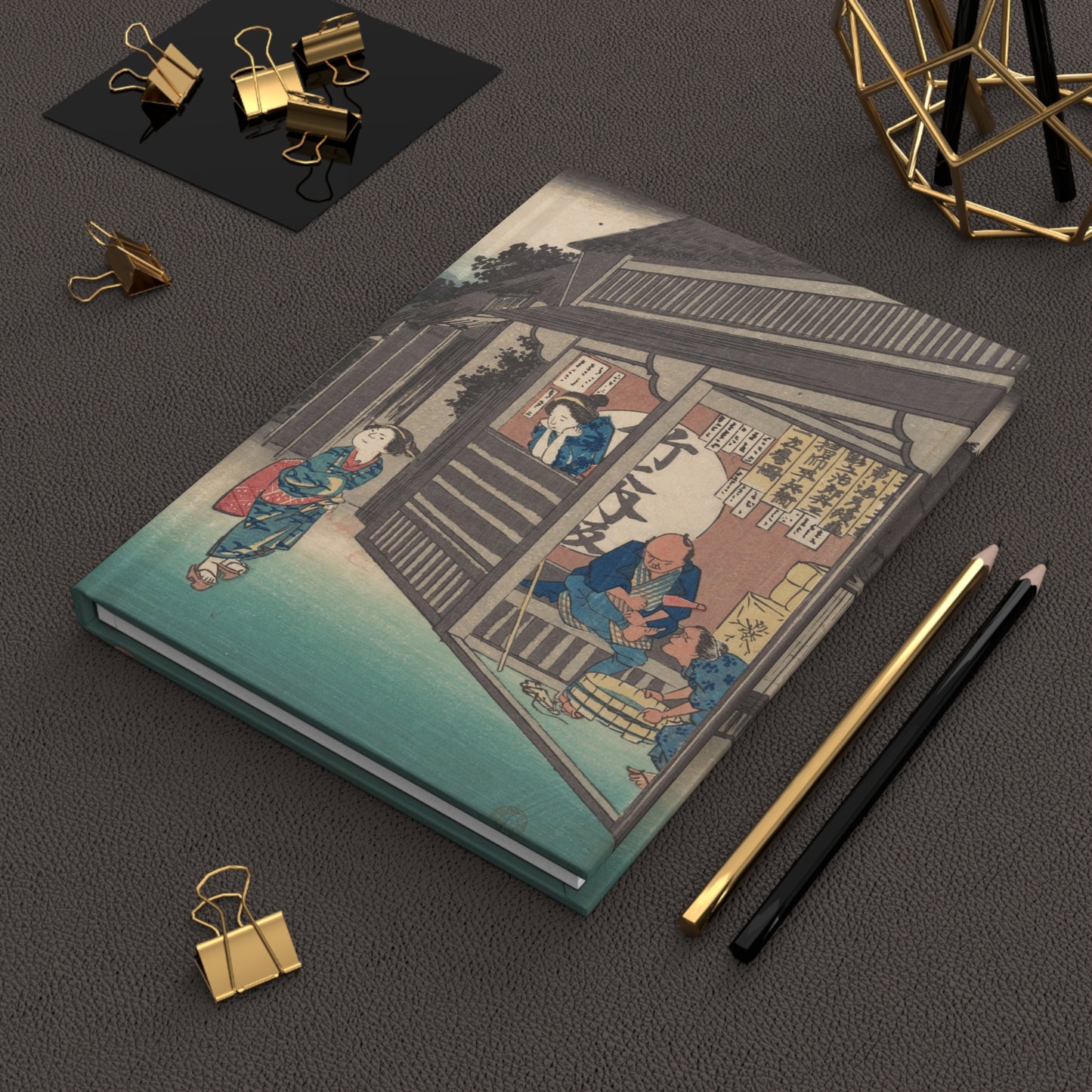
020 : Hiroshige - Women Accosting Travelers at Goyu
The Visual Language: Composition & Detail
Utagawa Hiroshige’s Women Accosting Travelers at Goyu (Goyu: Tabibito Tomeme) is highly regarded for its masterful use of linear perspective.
The street of the post town dramatically curves to the right and converges into the deep background, creating a profound sense of depth.
Against the serene, dusky atmosphere of the perfectly aligned inns fading into the twilight, the chaotic and dynamic movement of the figures in the foreground creates a striking visual contrast.
This juxtaposition between the tranquil, quiet setting and the lively, noisy human interactions is one of Hiroshige's signature compositional techniques.
The Cultural Soul: Symbolism & Philosophy
This print vividly captures the energetic, everyday reality of travel during the Edo period.
Goyu was a post town located extremely close to its neighboring station, Akasaka—only about 1.7 kilometers away, the shortest distance on the Tokaido.
Because of this proximity, the fierce competition for customers among the inns resulted in aggressive touting.
Here, Hiroshige comically depicts tomeme (female touts) forcefully grabbing the baggage and sleeves of passing travelers from behind, while the men frantically try to escape.
By focusing on such relatable, humanizing moments rather than idealized landscapes, Hiroshige conveys the true, humorous spirit of the common people traversing the famous highway.
Playful Details: Hidden Names and the "Ukiyo-e Uncles"
A fascinating aspect of this artwork lies in Hiroshige's playful, meta-theatrical details hidden within the scenery.
On the right side of the composition, a traveler is washing his feet to take off his straw sandals (waraji).
The wooden signs hanging above him ingeniously display the series title, Hiroshige's pen name, and even the names of the carver and printer, while the inn's wall deep in the background bears the name of the publisher (Hoeido).
This clever integration of production credits into the artwork itself showcases the witty, commercial spirit of ukiyo-e.
Furthermore, modern museums often affectionately refer to the expressive, comical men in Hiroshige's prints as "Ukiyo-e Uncles" (Ukiyo-e Ojisan), celebrating his unique ability to breathe vibrant, enduring life into these ordinary, middle-aged travelers.
Utagawa Hiroshige (1797–1858)

The legendary master of Ukiyo-e landscape prints who revolutionized the genre with his poetic use of light, season, and atmosphere.
Known for his lyrical compositions, his masterpiece "The Fifty-three Stations of the Tōkaidō" captured the heart of Edo Japan. His unique "Hiroshige Blue" and dynamic perspectives profoundly influenced Western artists like Van Gogh and Monet.
--------------------------------------------------------------------------------