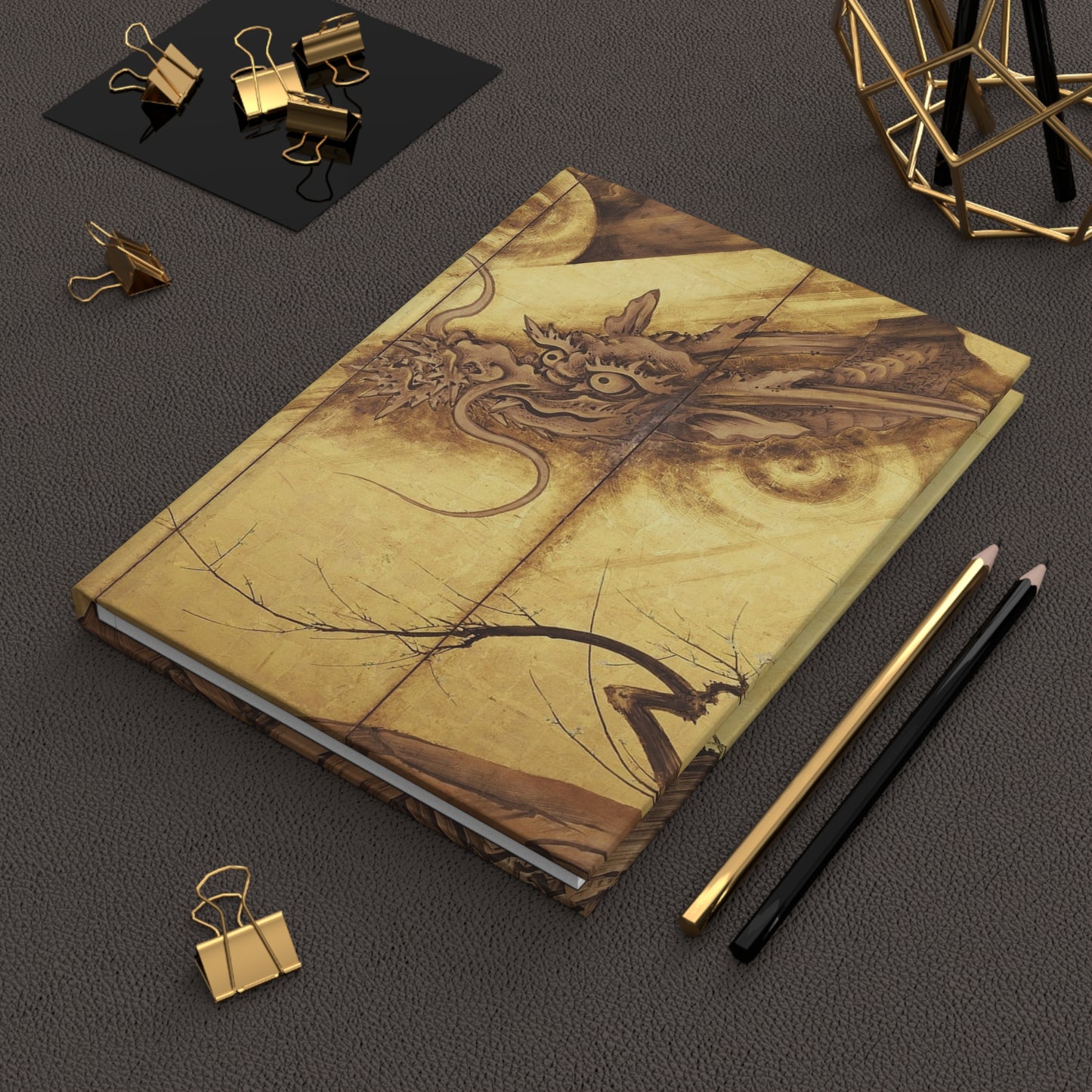
021 : Kano Sanraku - Dragon Screen (from Dragon and Tiger Screens)
The Visual Language: Composition & Detail
Kano Sanraku's Dragon Screen (the right half of the Dragon and Tiger Screens) is a monumental masterpiece from the early 17th century (Momoyama to early Edo period), originally housed at Myoshin-ji Temple and currently entrusted to the Kyoto National Museum.
Spanning a massive six-panel folding screen covered in brilliant gold leaf, the composition utilizes the sheer power of simple lines to emphasize the dragon's dynamic movement and speed.
The most striking visual element is the representation of wind and velocity. By deliberately minimizing background details, Sanraku allows the swirling clouds to slice diagonally across the golden space, acting almost like kinetic "speed lines" seen in modern comic books.
This linear and abstract approach creates an overwhelming sensation that the majestic dragon is rushing directly toward the viewer out of the void.
The Cultural Soul: Symbolism & Philosophy
As the direct disciple of the legendary Kano Eitoku and the founder of the "Kyo-Kano" (Kyoto Kano) school, Sanraku lived through a highly turbulent era, navigating the fall of his patrons, the Toyotomi clan.
In East Asian philosophy, the dragon is a sacred, mythical creature representing supreme spiritual power and the ruler of weather, capable of summoning clouds and rain.
Interestingly, the powerful gust of wind generated by the dragon in the right screen does not stop at the edge of the frame; it seamlessly flows into the left screen, causing the bamboo and grass surrounding the tiger to sway in the exact same direction.
Through this grand spatial design, Sanraku transformed the traditional face-off between two legendary beasts into a thrilling, singular narrative bound together by a continuous atmospheric current.
A Hidden Technique: The Illusion of Spontaneous Ink
At first glance, the dragon appears to have been painted with swift, spontaneous brushstrokes of black sumi ink directly onto the gold leaf.
However, close observation reveals an astonishingly complex, multi-layered process hidden beneath this seemingly effortless facade.
Sanraku first outlined the dragon with dark ink, then applied a thin layer of gofun (white shell pigment) inside the body to help the subsequent layers of pale ink adhere to the gold surface.
He then added countless short, dry brushstrokes to render the rough texture of the scales and skin.
Finally, he strategically placed highlights using gofun and kindei (gold pigment)—particularly concentrating the gold around the face and the swirling clouds—to intensify the dragon's piercing gaze and raw energy.
This dramatic gap between visual simplicity and painstakingly calculated technique is the true source of the dragon's timeless, heavy aura.
 Kano Sanraku (1559–1635)
The dynamic master of the Momoyama and early Edo periods who inherited the heroic spirit of Kano Eitoku and preserved the grandeur of the Kano school.
Renowned for his powerful brushwork and sweeping, dramatic compositions on sliding doors and screens, his art combined fierce energy with a refined elegance. His monumental masterpieces stand as a brilliant testament to the golden age of Japanese warrior-class aesthetics.
--------------------------------------------------------------------------------