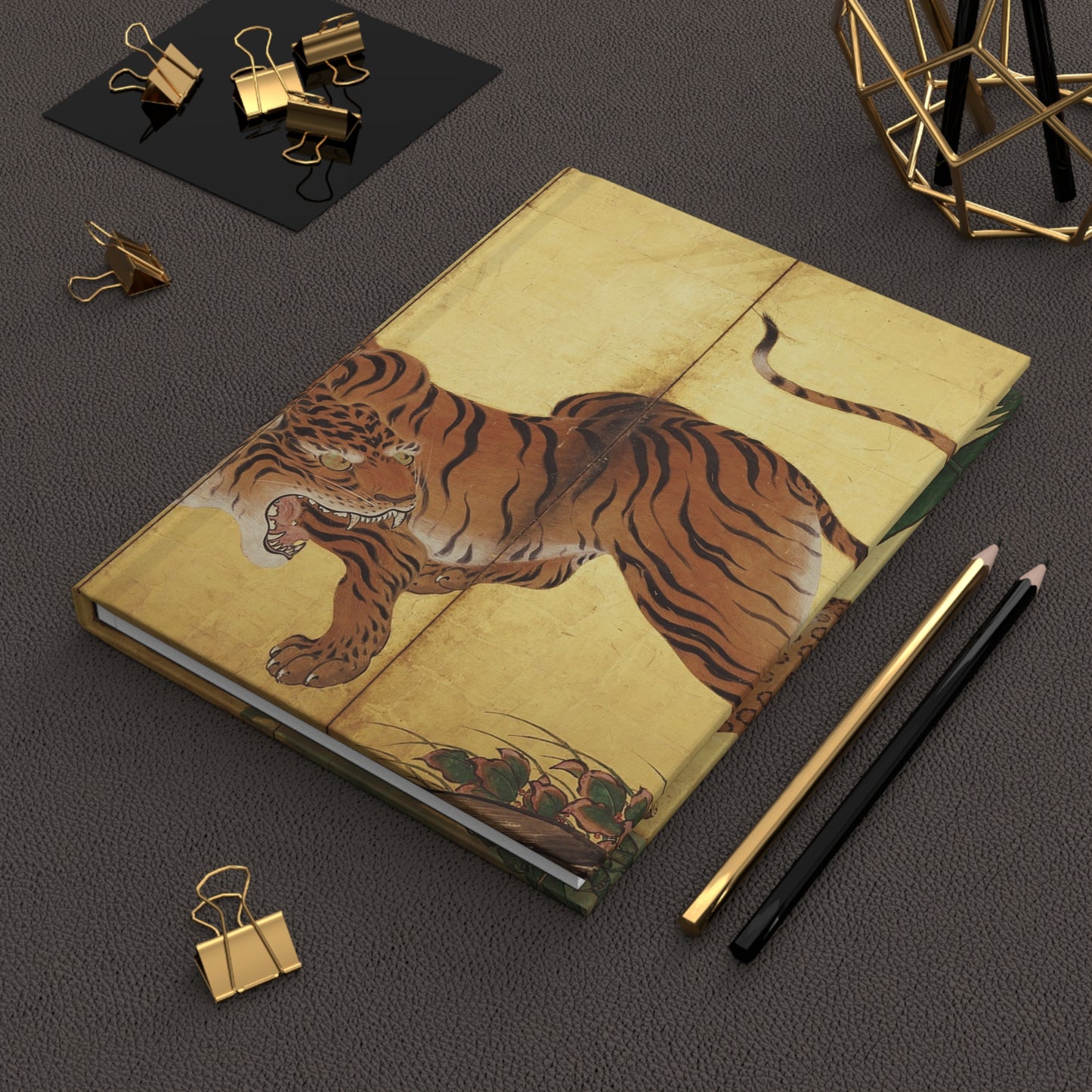
022 : Kano Sanraku - Tiger Screen (from Dragon and Tiger Screens)
The Visual Language: Composition & Detail
Kano Sanraku's Tiger Screen (the left half of the Dragon and Tiger Screens), originally housed at Myoshin-ji Temple and currently entrusted to the Kyoto National Museum, measures an impressive 178 by 360 centimeters—significantly larger than standard folding screens of its time.
Against a brilliant gold-leaf background, two tigers stand firmly on the earth.
The composition is dynamically intertwined with the right Dragon Screen; the fierce wind generated by the dragon in the other panel violently whips across this left screen, bending the thick trunk of a plum tree and flattening the bamboo grass.
Facing this invisible yet palpable gale, the roaring tiger pushes back with its sheer physical presence.
Sanraku masterfully contrasts the abstract, linear speed of the wind with the organic, supple curves of the tigers' bodies. Close observation reveals an astonishing level of detail, from each individual sharp tooth inside the roaring mouth to every single strand of the beasts' fine fur.
The Cultural Soul: Symbolism & Philosophy
A fascinating cultural detail in this painting is the depiction of the two felines. One has the familiar stripes of a tiger, while the other features the spots of a leopard.
During the Momoyama and Edo periods, live tigers did not exist in Japan, and it was widely believed that the leopard was simply the female tiger.
Thus, the two animals are affectionately depicted together as a mated pair.
In East Asian philosophy, the tiger represents the supreme ruler of the beasts and the earthly realm, making it a highly favored symbol of military prowess and absolute authority among samurai warlords.
Confronting the dragon—the ruler of the heavens—the tiger completes the ultimate cosmological balance of Yin and Yang, symbolizing the eternal tension and harmony of the universe's greatest forces.
An Imaginative Masterpiece: The Mystery of Authorship and Reality
Beyond its breathtaking impact, this artwork carries intriguing historical mysteries. For centuries, because the screens lacked the artist's signature or seal, temple tradition mistakenly attributed them to Kaiho Yusho, another master painter of the era.
It was only through modern art historical research by the scholar Tsugiyoshi Doi that the masterpiece was definitively reattributed to Kano Sanraku.
Furthermore, one must marvel at Sanraku’s extraordinary imagination. Having never seen a living tiger, he had to rely entirely on imported pelts, paintings from China, and his own boundless creativity to breathe such vivid, roaring life into these creatures.
His ability to conjure such an intensely realistic, awe-inspiring beast out of pure imagination cements his legacy as one of the greatest genius painters in Japanese history.
 Kano Sanraku (1559–1635)
The dynamic master of the Momoyama and early Edo periods who inherited the heroic spirit of Kano Eitoku and preserved the grandeur of the Kano school.
Renowned for his powerful brushwork and sweeping, dramatic compositions on sliding doors and screens, his art combined fierce energy with a refined elegance. His monumental masterpieces stand as a brilliant testament to the golden age of Japanese warrior-class aesthetics.
--------------------------------------------------------------------------------