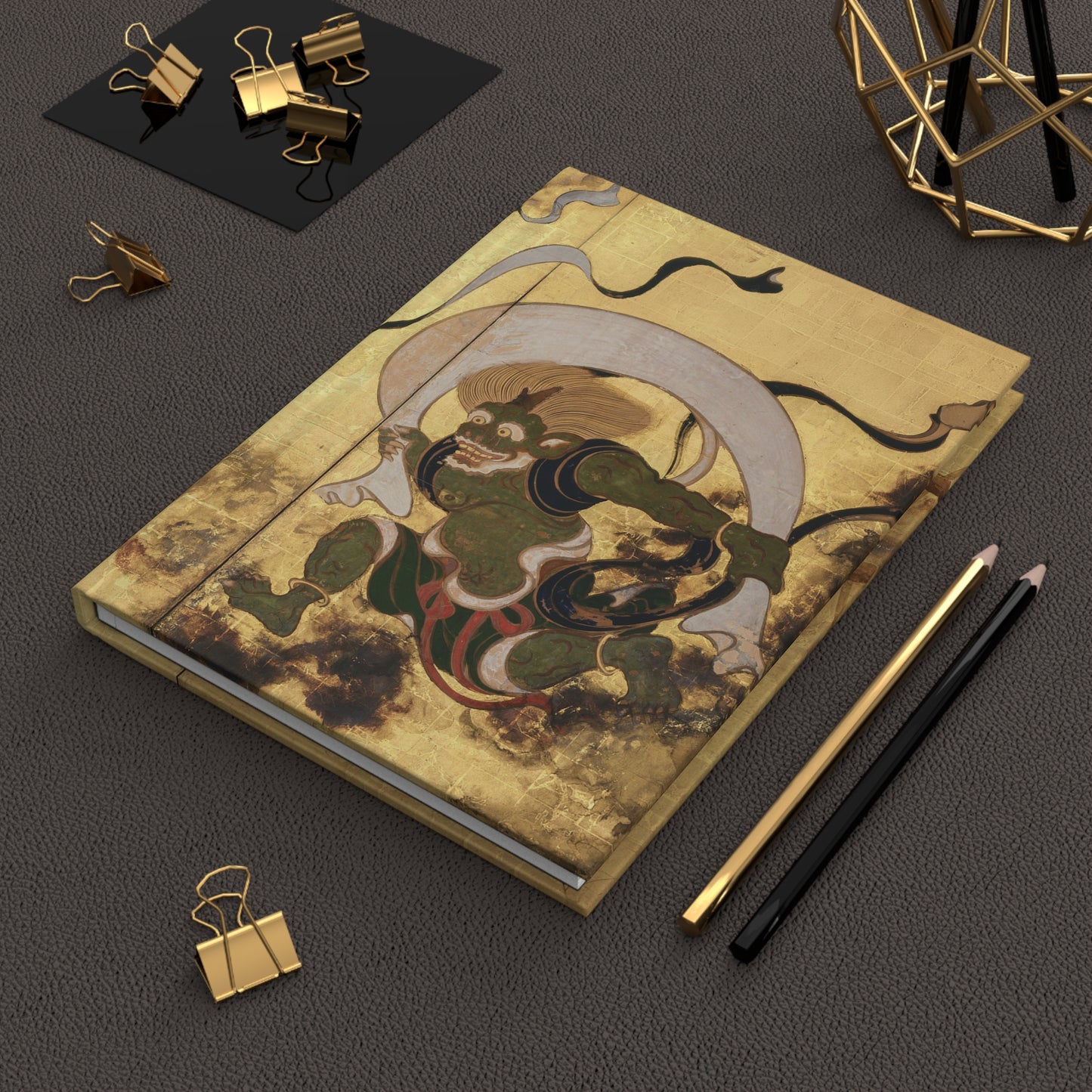
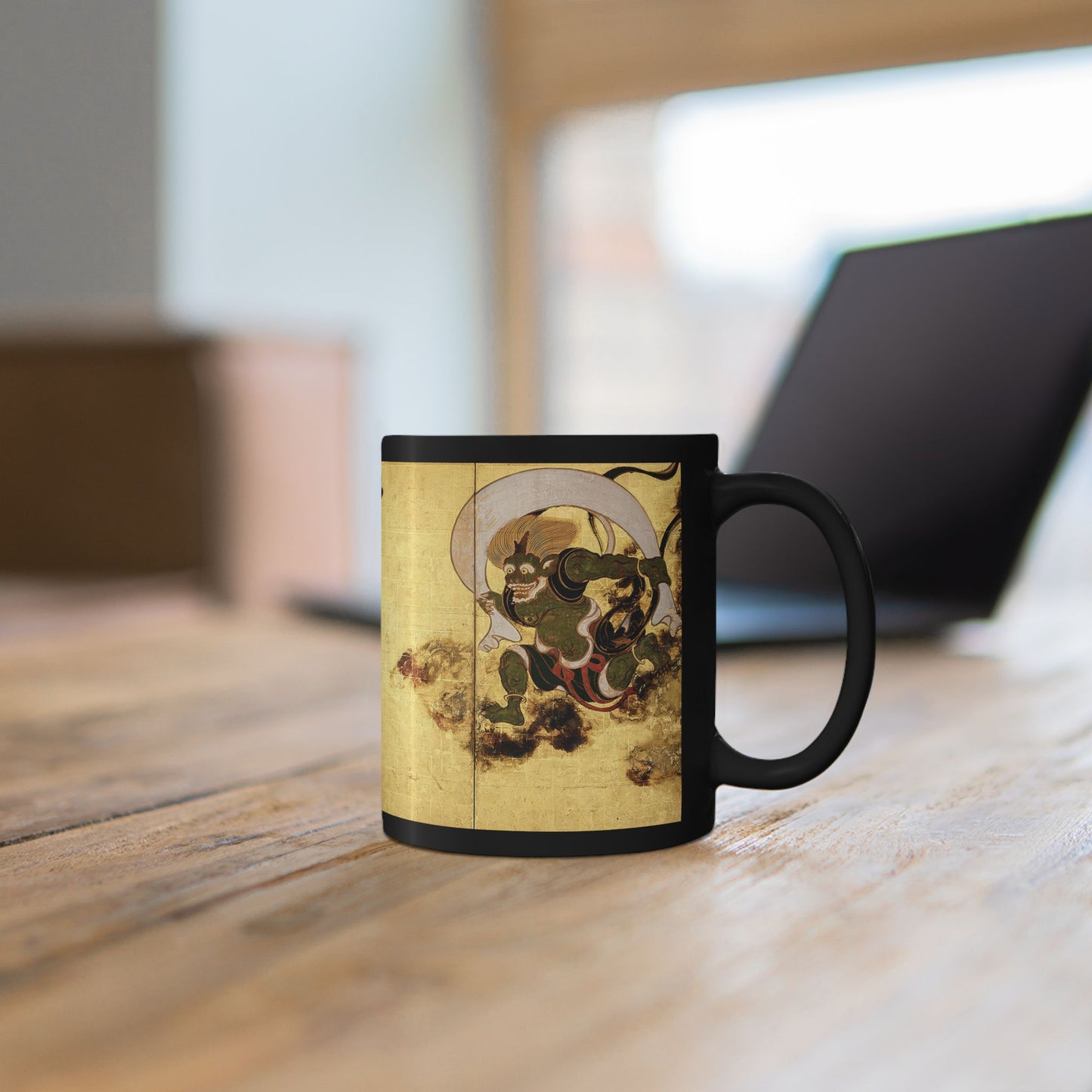
023 : Tawaraya Sotatsu - Wind God and Thunder God Screens
The Visual Language: Composition & Detail
Tawaraya Sotatsu’s Wind God and Thunder God Screens (Fujin Raijin-zu byobu) is widely regarded as the ultimate masterpiece of the Rinpa school.
Painted on a pair of two-panel folding screens covered entirely in brilliant gold leaf, the composition is astonishingly bold and modern.
The green-skinned Wind God on the right and the red-skinned Thunder God on the left are pushed to the extreme outer edges of the screens, leaving a vast, empty golden space in the center.
Sotatsu expertly employs a technique called tarashikomi—dropping ink, silver pigment, and water into still-wet areas—to create the thick, swelling black clouds that give the painting a profound sense of three-dimensionality and atmospheric depth.
The dynamic contrast between the vivid white, green, and red pigments of the gods against the shining gold background results in an overwhelming visual experience.
The Cultural Soul: Symbolism & Philosophy
Originally, the Wind God and the Thunder God were revered in Japanese nature worship and Buddhism as guardian deities—specifically, attendants to the Thousand-Armed Kannon.
However, Sotatsu transformed these fearsome religious icons into something more approachable and secular. Rather than terrifying demons, they are depicted with slightly humorous, human-like expressions.
Furthermore, recent studies suggest that this painting may have been created for use in imperial rituals praying for rain (kiu).
The vast golden void in the center is not merely an empty background; when placed in a Buddhist temple, it served to highlight the presence of an invisible Buddha or the infinite spiritual universe that these two deities were protecting.
A Legacy Across Centuries: The Magic of "Shishuku"
One of the most fascinating aspects of this artwork is how it shaped the history of Japanese art through a unique form of inheritance known as shishuku (secretly admiring and studying under a master without direct contact).
Sotatsu did not leave a signature or seal on this masterpiece. Yet, nearly a century later, the brilliant artist Ogata Korin was so moved by the painting that he created an exact replica.
A century after that, Sakai Hoitsu replicated Korin’s version. The Rinpa school was not passed down through bloodlines or direct master-to-apprentice training, but through this spiritual resonance across time and space.
The Wind God and Thunder God Screens stands as a timeless monument that connected the souls of three genius painters across three centuries.
Tawaraya Sotatsu (c. 1570–c. 1640) ※No surviving portraits exist.
The visionary pioneer of the Rimpa school who revolutionized traditional Japanese painting.Renowned for his dynamic compositions, innovative tarashikomi pooling technique, and poetic collaboration with calligraphy, his masterworks breathed new life into classical literature. His timeless design sensibility laid the foundation for the Rimpa aesthetic, profoundly shaping the trajectory of Japanese decorative arts for centuries to come.
--------------------------------------------------------------------------------