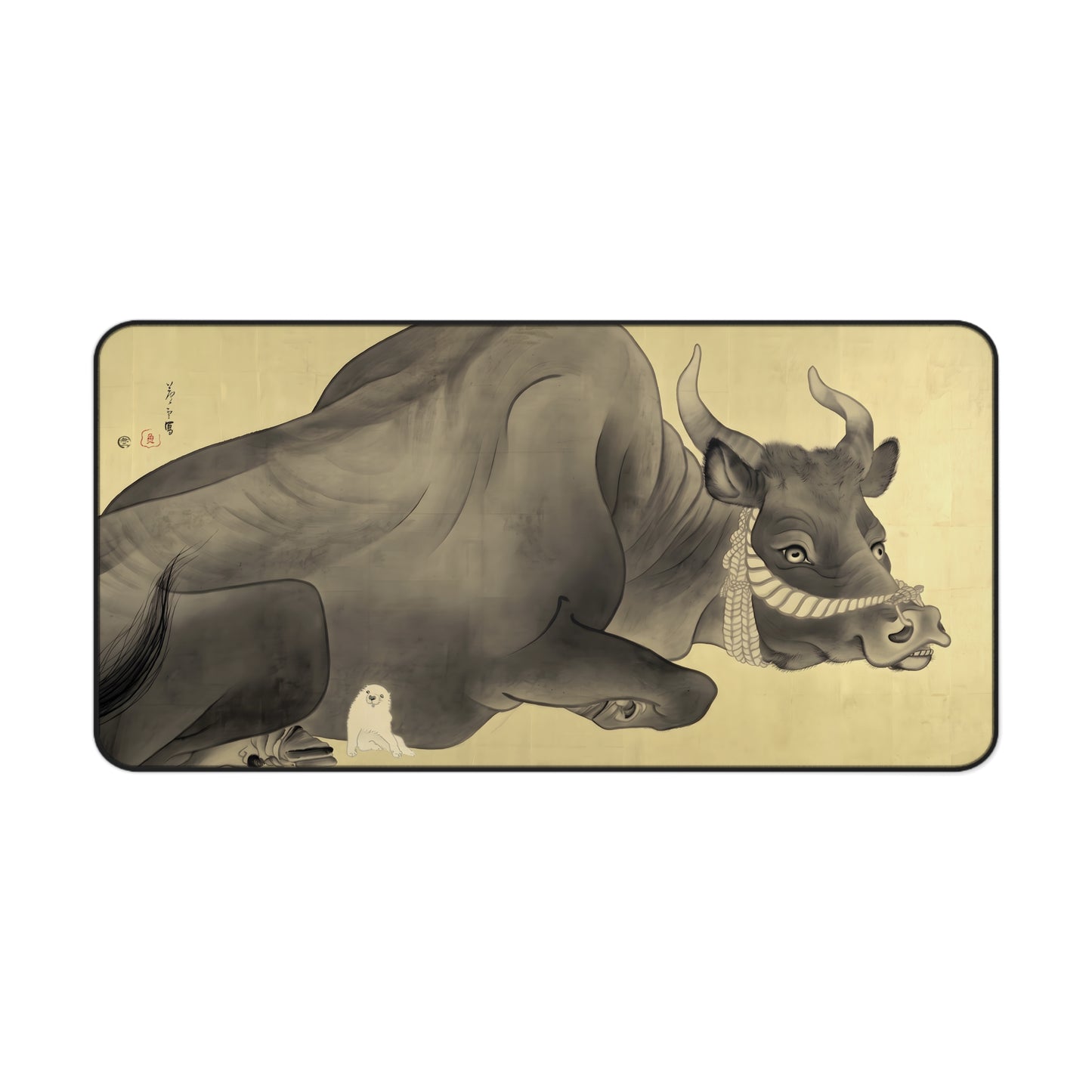
026 : Rosetsu - Black Bull and White Puppy (Left screen of White Elephant and Black Bull)
The Visual Language: Composition & Detail
Nagasawa Rosetsu’s White Elephant and Black Bull folding screens form a monumental pair, but the left screen featuring the "Black Bull and Puppy" is particularly striking for its extreme visual contrasts.
The composition revolves around the dramatic juxtaposition of scale and color. A colossal black bull, painted so massively that its body overflows the boundaries of the six-panel screen, dominates the pictorial space. Nestled comfortably against the bull's imposing, dark belly is a tiny, pure white puppy.
This bold arrangement directly contrasts with the right screen, which features a massive white elephant paired with a small black crow. While Rosetsu utilized the meticulous, realistic techniques inherited from the Maruyama school to render the bull's rough texture and weight, the puppy is painted with soft, simplified brushstrokes.
The Cultural Soul: Symbolism & Philosophy
Beyond its technical brilliance, this painting is widely celebrated today as a foundational work of Japan's enduring kawaii (cute) culture.
During the Edo period, painters often depicted fierce beasts to project authority, but Rosetsu directed his warm, compassionate gaze toward weak, innocent, and everyday creatures. The puppy, with its wide, rounded eyes and relaxed posture, evokes an endearing, whimsical charm (yurukawa) that remarkably anticipates Japan's modern mascot

and character culture.
Furthermore, the pairing of the black bull and the white puppy—along with the white elephant and black crow—subtly plays with the East Asian philosophical concept of Yin and Yang, representing a harmonious balance of opposing forces.
By placing this innocent puppy against the overwhelming mass of the bull, Rosetsu creates a gentle, humorous universe that subverts hierarchical authority, proving his philosophy that "cuteness" alone possesses a profound power to captivate the human heart.
The Eccentric Rebel and the Broken Seal
Rosetsu's artistic journey is as fascinating as his paintings. As the star disciple of Maruyama Okyo, the great master of realism, Rosetsu possessed undeniable technical skill. However, his free-spirited, eccentric, and occasionally arrogant personality led to legendary anecdotes.
One famous tale claims he submitted Okyo's own instructional drawing as his original work; when Okyo unknowingly corrected his own drawing, Rosetsu revealed the trick, leading to his expulsion from the school.

This rebellious, liberated spirit is perfectly symbolized by his famous square seal reading "Fish" (Uo), shaped like a block of ice. According to lore, after seeing a fish trapped in winter ice that eventually swam free as the ice melted, Rosetsu deliberately chipped the corner of his own seal to declare his emancipation from the rigid constraints of his master's style.
The Black Bull and Puppy is the ultimate manifestation of this freedom—a masterpiece where absolute technical mastery is playfully concealed behind an irresistibly adorable smile.

Nagasawa Rosetsu (1754–1799)
An eccentric genius of the Edo period who redefined traditional ink painting with daring originality.Grounded in precise realism, he shattered convention through dramatic perspectives, bold brushwork, and witty, charming depictions of animals. His innovative spirit and dynamic compositions continue to captivate art lovers worldwide.