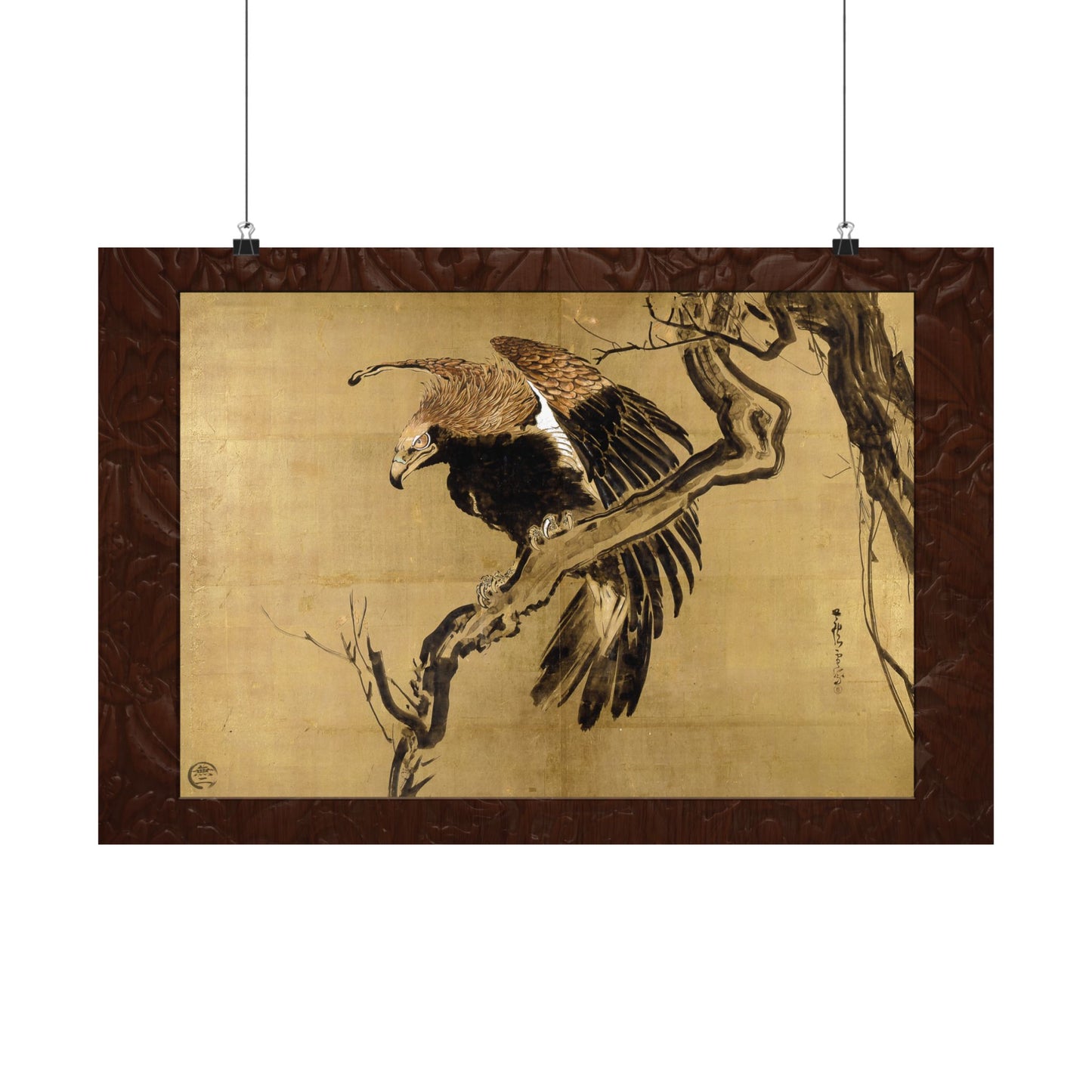
028 : Eagle on a Branch - Nagasawa Rosetsu
The Visual Language: Composition & Detail
Nagasawa Rosetsu’s Eagle on a Branch (Eda-ni-tomaru-Washi-zu) is a powerful testament to the artist’s raw expressive power and spatial ingenuity.
Painted in monochrome ink on paper, the composition depicts a solitary eagle perched upon a gnarled, weathered tree branch.
Rosetsu immediately establishes a sense of sudden, quiet tension through a calculated asymmetric composition.
The massive, diagonal thrust of the branch slices dramatically across the frame, providing both a physical perch for the bird and a kinetic directional force for the viewer’s eye.
Rather than utilizing the meticulously blended washes typical of the orthodox Maruyama school, Rosetsu defines the eagle with coarse, uninhibited brushstrokes.
The feathers of the eagle are rendered with layers of dry ink (kasure) and aggressive, rapid lines, conveying the untamed, sharp texture of the predator's plumage.
Beneath the bird, the rough bark of the ancient branch is created through bold, visceral ink strokes, highlighting the tactile contrast between the living predator and the decaying wood.
The most profound visual element of the painting, however, is its masterly use of yohaku (negative space).
The background is left entirely untouched, representing a vast, infinite void that surrounds the solitary hunter.
By isolating the eagle against this empty expanse, Rosetsu amplifies the bird’s absolute focus and terrifying isolation.
This absolute simplification of space forces the viewer into a meditative state of direct observation, echoing the immediate, raw reality of nature.
The Cultural Soul: Symbolism & Philosophy
In East Asian mythology and Japanese feudal culture, the eagle (washi) and hawk (taka) were highly revered motifs.
During the Edo period, these fierce birds of prey served as potent symbols of military prowess (bugei), absolute authority, and the noble status of the samurai class.
Falconry (takagari) was a prestigious and closely guarded pastime reserved strictly for the shogun and elite territorial lords (daimyo).
As such, orthodox bird-of-prey paintings were typically commissioned to visually project the patron's absolute political power and dominance.
However, Rosetsu’s Eagle on a Branch transcends these rigid, political frameworks.
Rather than presenting a stylized, heraldic icon of military propaganda, Rosetsu directs his compassionate gaze toward the raw, naturalistic essence of the beast.
His eagle is not posing for a lord; it is a wild creature frozen in a moment of intense, instinctual focus.
The contrast between the sharp, piercing gaze of the eagle and the profound, silent emptiness of the yohaku reflects a deep Zen-like philosophical inquiry.
In Zen philosophy, the concept of yohaku represents the primordial void from which all form arises and to which all form returns.
By placing the hyper-focused predator in this vast emptiness, Rosetsu captures the harmonious tension of the universe: the coexistence of intense life force and absolute stillness.
Through this poignant, poetic lens, the eagle is stripped of its samurai armor and restored to its true, sacred place within the transience of the natural world.
Behind the Brush: A Cross-Era Dialogue on the Reverse Side
A highly fascinating and dramatic aspect of this artwork lies not just on its surface, but on what was later mounted on its reverse side.
The scroll preserved in the collection of the Indianapolis Museum of Art is a double-sided masterpiece (ryomen-ga).
On the front side, viewers are confronted by Rosetsu’s fierce, monochrome Eagle on a Branch.
But when the scroll is turned over, it reveals a breathtaking painting titled Carp in Waves by Shibata Zeshin (1807–1891), the legendary lacquer artist and painter who dominated the late Edo and Meiji periods.
This extraordinary mounting creates a profound, multi-generational artistic dialogue across a single piece of paper.
Rosetsu’s bold, 18th-century "eccentric" ink style is placed in direct, physical juxtaposition with Zeshin’s 19th-century refined and fluid realism.
The two works establish an exquisite thematic and physical contrast.
While Rosetsu’s side captures "Stillness and Danger" through a solitary predator waiting in the cold, dry void, Zeshin’s reverse side expresses "Movement and Vitality" through a sleek carp swimming dynamically against an energetic, swirling current of water.
This miracle of mounting culture demonstrates the unique Japanese aesthetic of appreciating art as an interactive, multi-dimensional object.
It is highly likely that a discerning late 19th-century collector or mounter recognized the spiritual resonance between these two Kyoto-born geniuses of different eras.
By uniting them back-to-back, they created a timeless visual symphony of yin and yang, air and water, predator and prey—proving that true artistic genius knows no boundaries of time.

Nagasawa Rosetsu (1754–1799)
An eccentric genius of the Edo period who redefined traditional ink painting with daring originality.Grounded in precise realism, he shattered convention through dramatic perspectives, bold brushwork, and witty, charming depictions of animals. His innovative spirit and dynamic compositions continue to captivate art lovers worldwide.