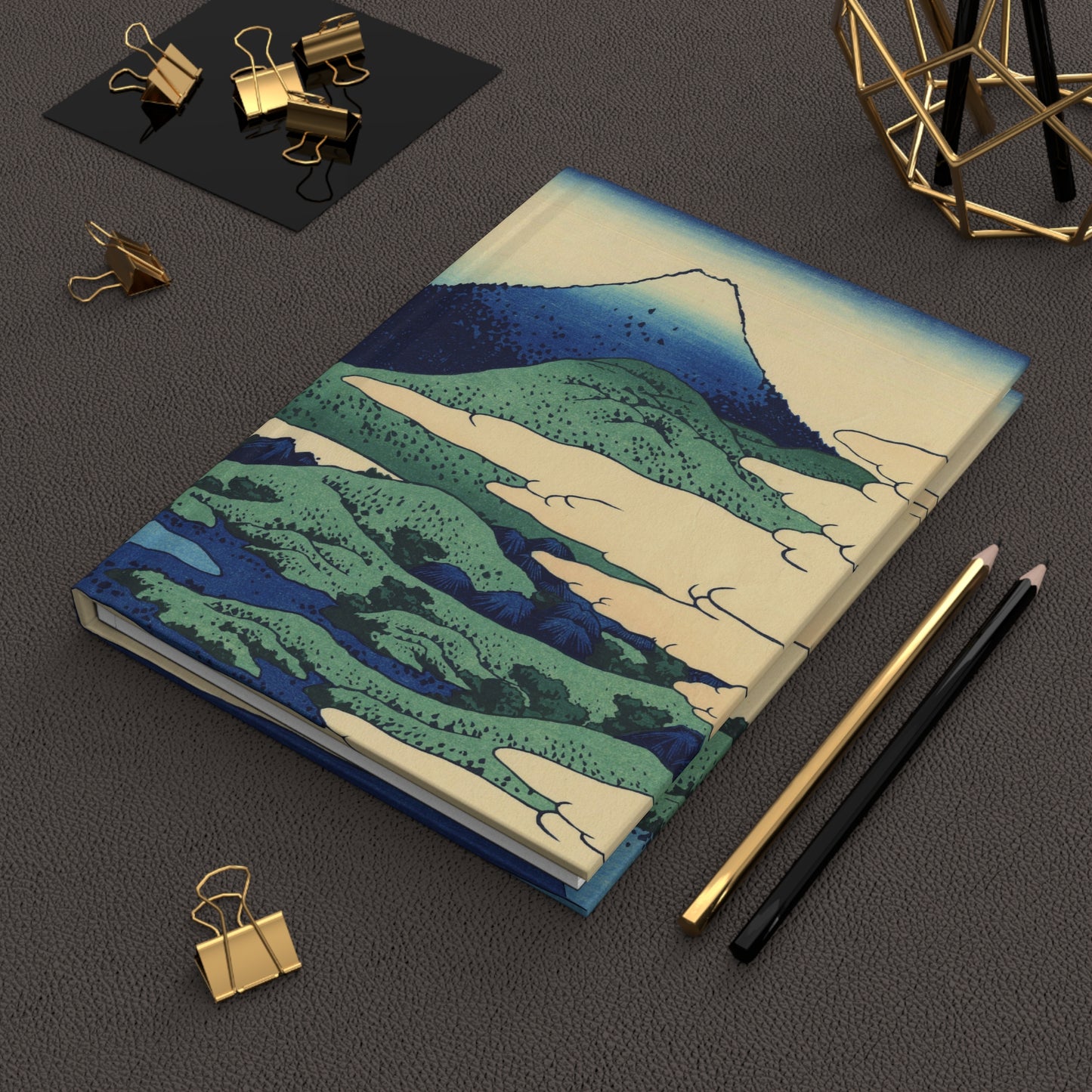
002 : Hokusai - Umezawa in Sagami Province
The Visual Language: Composition & Detail
Katsushika Hokusai’s Umezawa Hamlet-fields in Sagami Province (from the Thirty-Six Views of Mount Fuji series) is a masterful display of atmospheric perspective and color harmony.
The composition is anchored by the majestic peak of Mount Fuji in the background and the gently rounded form of Mount Yagura in the foreground.

The scene captures the crisp, clear air of a breaking dawn, achieved through a sophisticated "aizuri" (blue-printed) technique.
Hokusai masterfully utilizes Prussian blue—an imported synthetic pigment that was highly popular at the time—creating deep, resonant gradations across the landscape.
The visual rhythm is further enhanced by the placement of seven red-crowned cranes: five foraging peacefully by the water's edge and two gliding gracefully toward the sacred mountain.
The Cultural Soul: Symbolism & Philosophy
Beyond its serene landscape, this print functions as a profound kisshōga (auspicious picture).
The cranes are universally recognized in Japanese culture as symbols of good fortune, and their presence transforms the scene into an idealized utopia reminiscent of the mythical Mount Horai.

Interestingly, the location, Umezawa, was a bustling rest stop (tateba) on the Tokaido road between the Oiso and Odawara post stations.
Yet, Hokusai deliberately strips away the noise of human activity, choosing not to depict the travelers or teahouses that would have been common in reality.
Instead, he created a quiet, spiritual realm that reflects the deep reverence for Mount Fuji as an eternal and sacred presence.
A Hidden Story: The Engraver's Error and Modern Local Legacy
While this print is celebrated for its serene beauty, it also holds unique stories that extend beyond the artwork itself.
First is a typographical mystery in its title. The word "Hidari" (Left) in the title "Umezawa-hidari" makes little geographical sense.

Scholars widely believe this was an engraver's error, likely a mistake for visually similar kanji characters like "Sho" (Manor) or "Zai" (Rural area).
Furthermore, Hokusai’s vision of Umezawa is not merely a relic of the past; it continues to live on in the local community today.
In modern Ninomiya Town, where Umezawa is located, the local people have initiated a revitalization project named "Area 8.5".
This nickname comes from the town's location between the 8th (Oiso) and 9th (Odawara) post stations of the old Tokaido road.
Hokusai's print has been recreated as a mural on modern buildings in the town, proving that the legacy of this artwork remains a vibrant, living part of Japan's local heritage.
 Katsushika Hokusai (1760–1849)