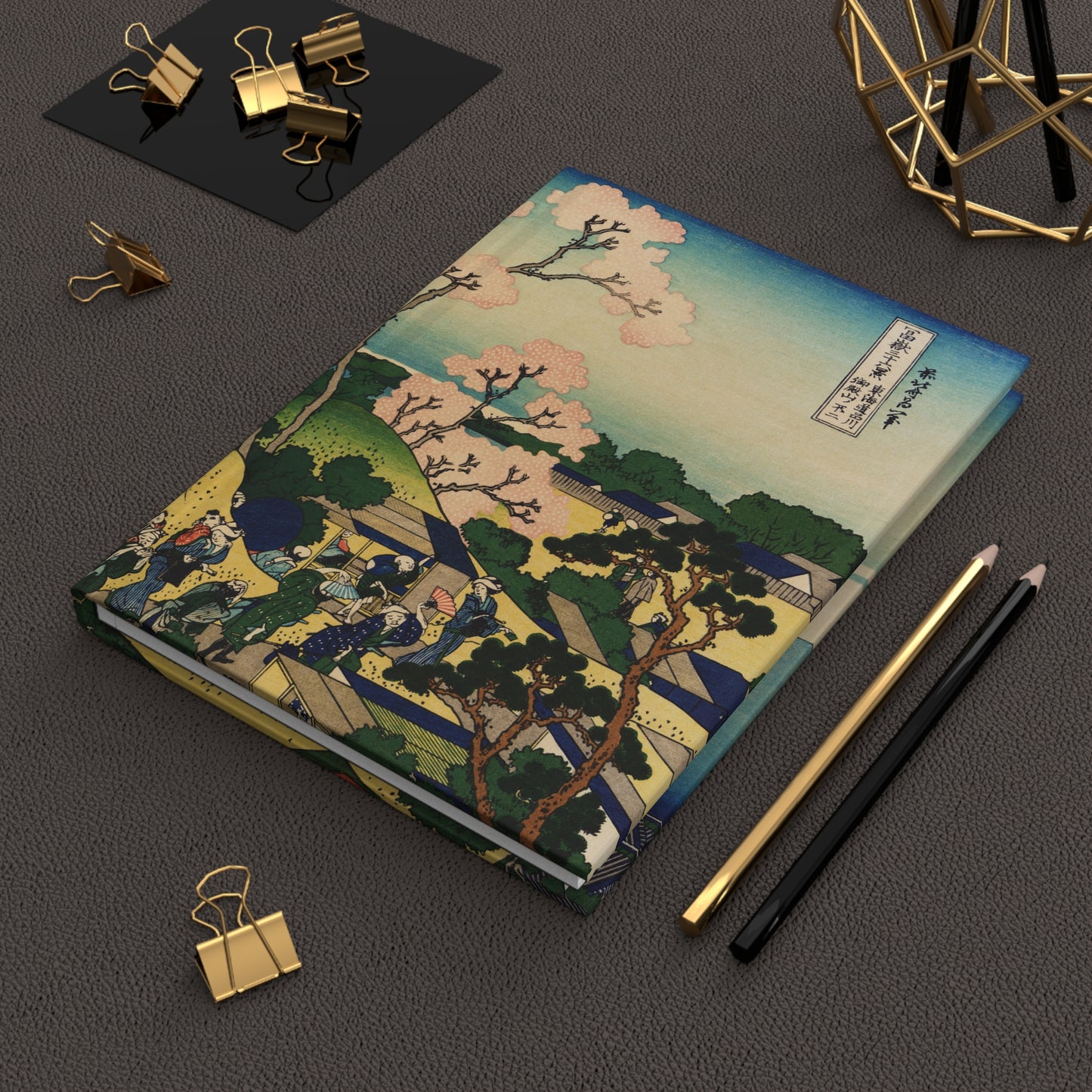
003 : Hokusai - Fuji from Gotenyama at Shinagawa on the Tokaido
The Visual Language: Composition & Detail
Katsushika Hokusai’s Fuji from Gotenyama at Shinagawa on the Tokaido (from the Thirty-Six Views of Mount Fuji series) is a brilliant example of spatial organization and technical ingenuity.
Hokusai employs a bird's-eye view that allows the viewer to simultaneously take in the lively crowds and the expansive landscape.

The composition is meticulously calculated so that the bustling cherry blossom viewers are contained in the foreground, aligning the viewer, the blossoms, and the sacred mountain on a single horizontal axis.
Furthermore, Hokusai creatively utilizes the natural wood grain of the printing block to represent the gentle ripples of Edo Bay, showcasing the unique textural qualities inherent in the woodblock printing process.
The Cultural Soul: Symbolism & Philosophy
This print beautifully captures the spirit of hanami, the traditional Japanese custom of cherry blossom viewing.
Gotenyama was famously developed as a public viewing spot by the eighth shogun,

Tokugawa Yoshimune. In the foreground, people from various walks of life—samurai, commoners, and families with children—are depicted in a state of uninhibited joy, sharing drinks, relaxing on mats, and playfully dancing.
The artwork presents a profound philosophical contrast: the ephemeral beauty of the cherry blossoms and the lively, fleeting moments of human merriment, juxtaposed against the distant, dignified, and eternal presence of Mount Fuji.
A Fictional Landscape and a Lost Paradise
Beyond its aesthetic charm, this print reveals Hokusai's bold approach to reality.
Geographically, looking toward Edo Bay from Gotenyama means facing east, making it impossible to see Mount Fuji, which lies to the west.

Hokusai intentionally ignored this geographic fact, and it appears he even visually removed obstructing cherry branches to create an idealized, fictional composition that prioritized artistic perfection over reality.
Ironically, this beautifully crafted landscape met a tragic real-world fate.
At the end of the Edo period, the hill of Gotenyama was dismantled to construct maritime forts (Daiba) in Shinagawa.
Today, the hill has been destroyed, leaving only its name behind. Thus, Hokusai’s vibrant depiction stands as a precious record of a lost paradise.
 Katsushika Hokusai (1760–1849)