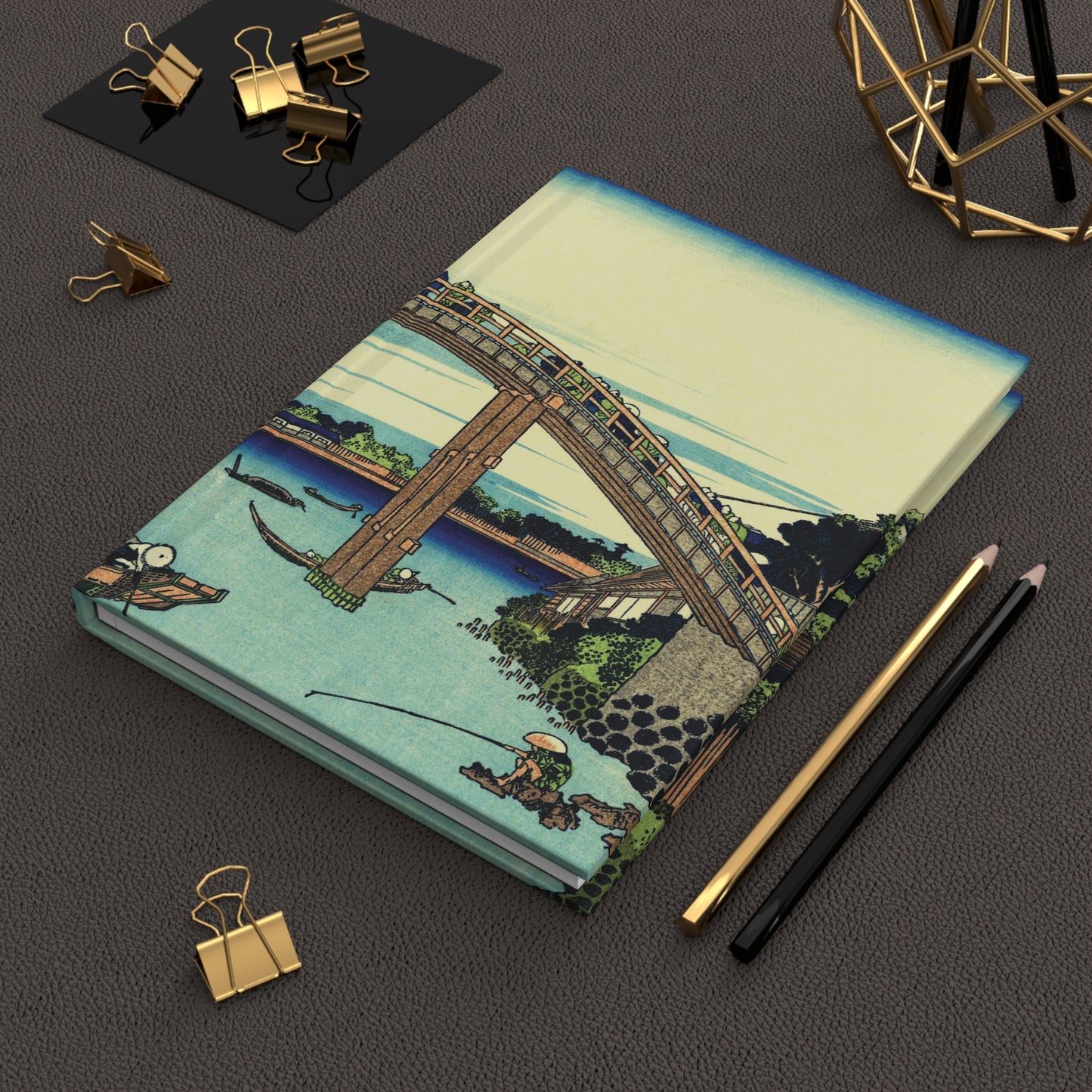
001 : Hokusai - Mannen Bridge at Fukagawa
The Visual Language:Composition and Detail
Katsushika Hokusai’s "Under the Mannen Bridge at Fukagawa" is a masterful demonstration of structural geometry and color precision. The print features the sweeping, elegant arch of the Mannen Bridge, which spanned the Onagigawa River just before it converged with the Sumida River.

Hokusai utilizes differing shades of blue to distinguish the waterways, applying a lighter blue for the Onagigawa and a deeper hue for the Sumida.
Most notably, the composition reflects a fascinating hybrid of eastern and western visual systems. Hokusai incorporates Western linear perspective—evident in the gradual diminishing size of the buildings receding into the distance—while retaining a shallower, raditional Japanese decorative space.
The entire piece is anchored by the innovative use of imported Prussian blue, which was even utilized to print the key-block outlines, lending the artwork a striking and cohesive atmosphere.
The Cultural Soul:Symbolism and Philosophy
Beyond its structural beauty, the print carries deep spiritual and cultural resonance. Hokusai employs a framing technique known as torii-mitate, visually placing the distant Mount Fuji beneath the bridge's arch as if the bridge itself were a torii (a sacred Shinto shrine gate)

This clever composition effectively transforms the bustling Edo waterways into a sacred space, enveloping the daily lives of commoners within the spiritual realm of the mountain.
The boats on the water intentionally point their prows toward Fuji, directing both the physical momentum of the scene and the viewer's gaze toward the sacred peak.
Furthermore, the artwork contains a hidden layer of auspicious wordplay: combining "Mannen" (Ten Thousand Years) from the bridge's name with "Sengen" (One Thousand), an alternate reading for the Fuji faith, evokes the traditional Japanese pairing of the crane and the turtle, universal symbols of longevity and good fortune.
A Legacy of Innovation:Influence on Global Art
The innovative approach Hokusai took in this print and his broader Thirty-Six Views of Mount Fuji series reverberated far beyond the borders of Japan, and fundamentally altering the trajectory of Western art.
When Japan's borders opened, these ukiyo-e prints flooded Europe, sparking the aesthetic phenomenon of Japonism.

The European avant-garde, particularly the Impressionists and Post-Impressionists, were deeply struck by Hokusai's brilliant use of solid colors, simplified contours, and flattened, asymmetrical perspectives.
Claude Monet's famous paintings of his Japanese bridge were directly inspired by Hokusai's bridge landscapes, including "Under the Mannen Bridge at Fukagawa".
Similarly, Vincent van Gogh was profoundly moved by the bold colors and dynamic compositions found in Japanese prints.
Ultimately, Hokusai’s unique synthesis of Eastern and Western aesthetics engaged in a subtle global dialogue, acting as a crucial catalyst for the birth of modern art.
 Katsushika Hokusai (1760–1849)