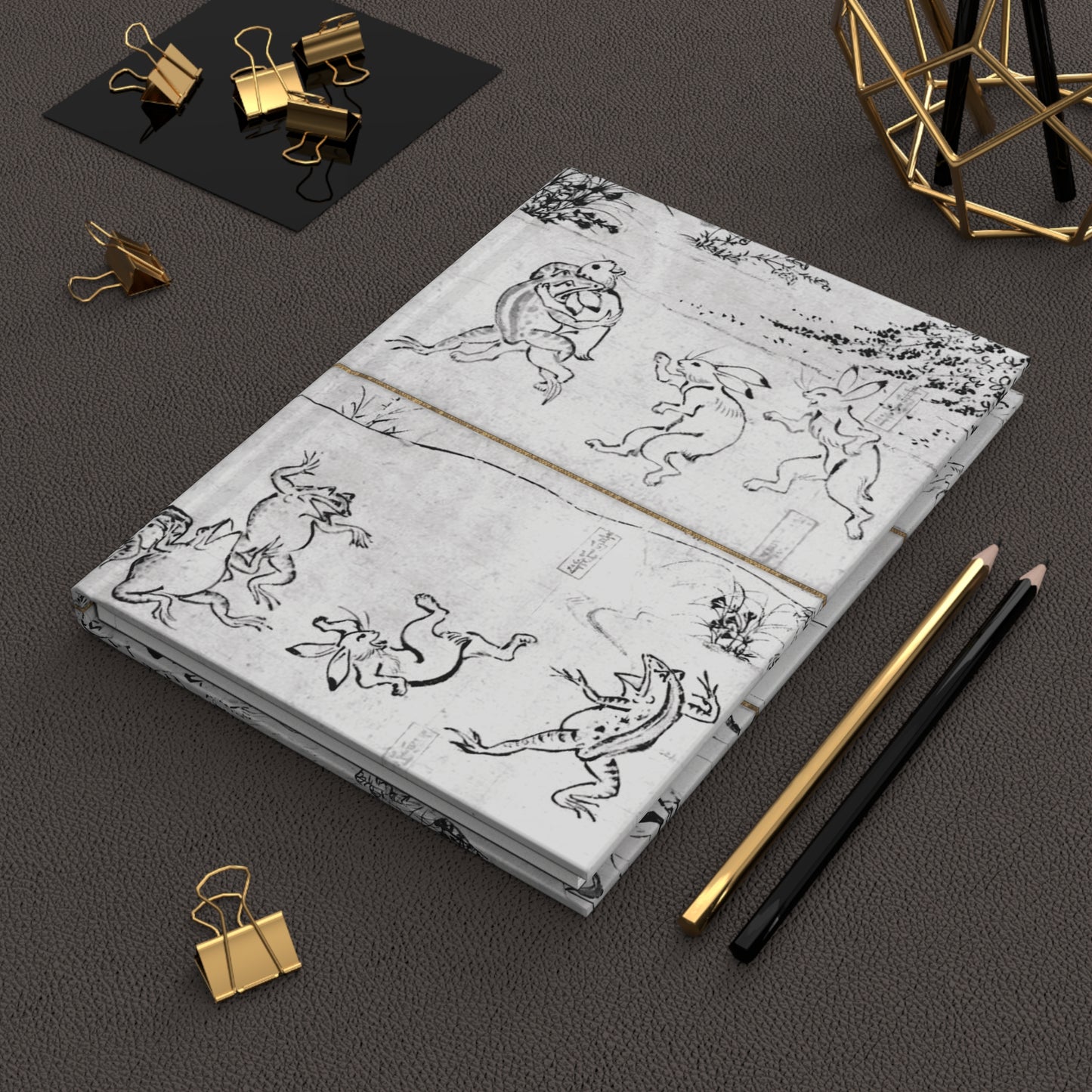
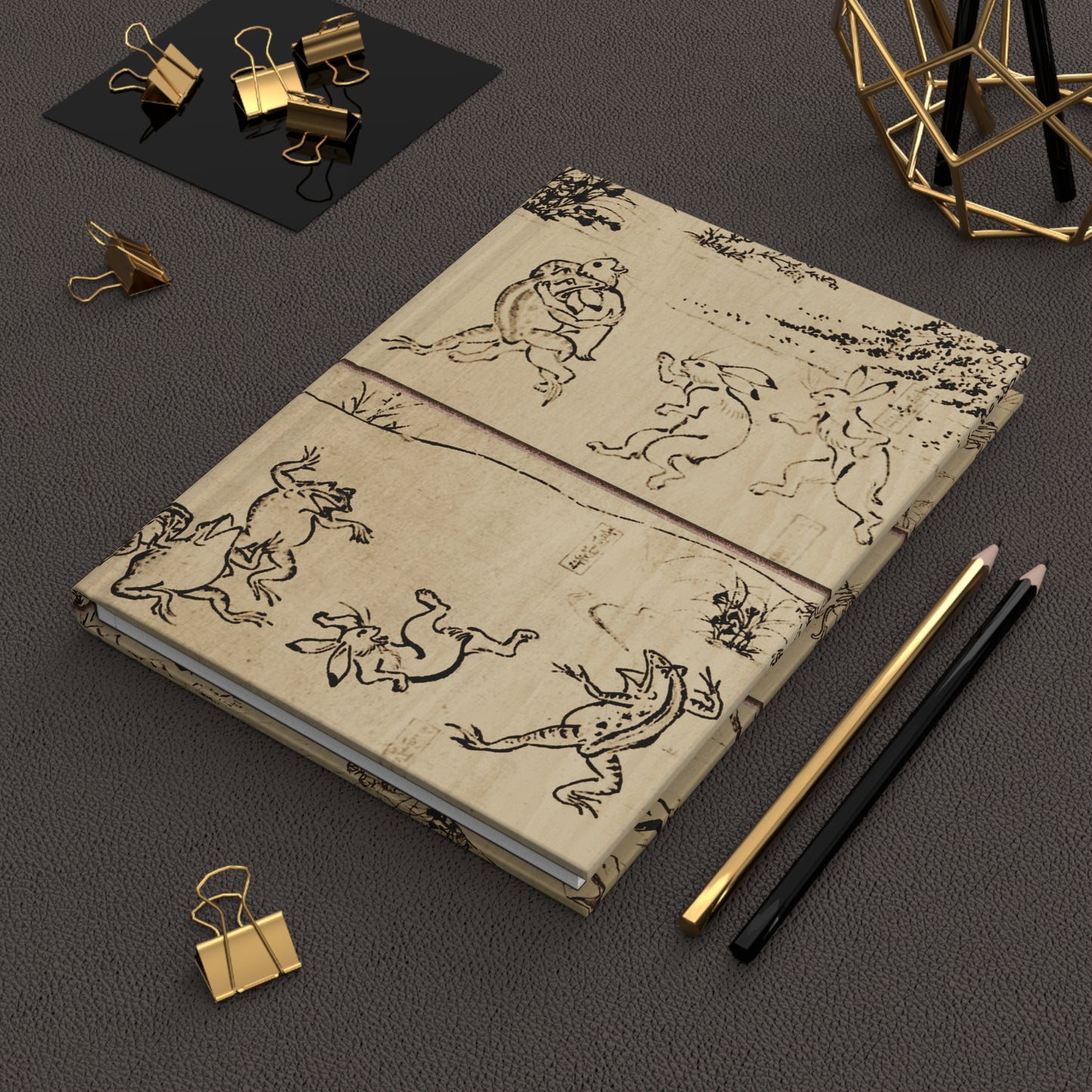
010 : Choju-giga (Scrolls of Frolicking Animals)
The Visual Language: Composition & Detail
Dating back to the 12th and 13th centuries, Choju-giga (The Scrolls of Frolicking Animals) is a monumental masterpiece spanning four scrolls—Scrolls A, B, C, and D—and totaling approximately 44 meters in length.
The most striking visual characteristic of this work is its hakubyo technique—a monochromatic linear drawing style that uses only black ink without any added color.
Because color cannot mask mistakes, this method requires the artist to capture dynamic movement and complex expressions in a single, uncorrectable stroke, demonstrating extraordinary technical mastery.
Furthermore, the scroll employs a sophisticated compositional method known as ijidozu (different time, same space), where the same characters are depicted repeatedly in one continuous landscape to illustrate the passage of time as the viewer unrolls the scroll from right to left.
The simple, flowing brushwork effortlessly guides the viewer's eye, establishing a rhythmic visual pacing that remains captivating centuries later.
The Cultural Soul: Symbolism & Philosophy
Scroll A, the most famous of the four, features rabbits, frogs, and monkeys behaving entirely like humans—wrestling, shooting bows, hosting banquets, and even performing Buddhist rituals.
While seemingly lighthearted and humorous, scholars suggest that these anthropomorphized animals serve as a clever vehicle for social satire.
By projecting human activities onto woodland creatures, the anonymous artists could indirectly critique the power dynamics, religious institutions, and social hierarchies of medieval Japan.
Interestingly, amidst the human-like animals, the scroll also includes non-anthropomorphized creatures like snakes and owls.
The owl, quietly observing a ceremony from a tree, is thought to represent an objective, omniscient narrator's gaze, connecting the inner world of the scroll with the viewer outside.
The decision to completely omit written text invites viewers to interpret the deeper, hidden philosophy of the work through their own imagination.
The Genesis of Pop Culture: Roots of Manga and Animation
Today, Choju-giga is widely celebrated worldwide as "Japan's oldest manga" and the ancient precursor to modern animation.
Over 800 years ago, the creators of this scroll were already employing visual storytelling techniques that are foundational to contemporary comic books.
For instance, the artists utilized kinetic lines (effect lines) to depict spinning weapons and subtle strokes near a frog's mouth to signify croaking—an early prototype of the speech bubble.
Moreover, the act of viewing a handscroll is inherently cinematic; as the viewer unrolls the paper, new scenes are revealed sequentially, making the characters appear as if they are coming to life and moving across the frame.
This mastery of continuous, wordless visual narrative proves that the playful, dynamic spirit characterizing modern Japanese pop culture has deep roots in the nation's traditional heritage.